“ONE + MANY” – Addition Turns into Multiplication

ZHEJIANG UNIVERSITY’S FOCUSED STRATEGY FOR CAMPUS GLOBALIZATION
With 7,000 on-campus international students, ZJU has quickly become a symbol of China’s rapid globalization. Their EAST MEETS WEST philosophy shows how the alumni’s diversepride in their historic university leads to successful growth.
Moving Fast Toward Internationalization
Located near West Lake, a UNESCO World Heritage site, and the headquarters of Alibaba; one of the 10 largest companies in the world, Zhejiang university (ZJU)’s main campus in Hangzhou City represents an innovative mix of tradition and modern technology. The university shifted gears toward aggressive internationalization in 2016 when the city held the first ever G20 summit in China.
“Over the past couple of years, most of the top universities in China started focusing on internationalization, but I would say ZJU has been a fast-mover,” Lianzhen remarks. “We have created a new strategy ‘Global ZJU – CREATE to Impact’. As part of this strategy, we aim to make an impact on the global society through a wide range of initiatives that are not limited to within China. Internationalization is the key to achieve this vision.”
In 2018, the number of international students in ZJU reached 7,000, twice the number of students in Tsinghua university which is ranked as Asia’s Top University by Times Higher Education (THE), and 1.6 times more than the number of students in University of Tokyo. They set a challenging target of sending all the Chinese students in the university to study overseas. In 2018 they achieved 74% of this target. Their position in THE’s World University Ranking jumped from 301-350 to 101 in the last six years.
We posited that this achievement can be attributed to their specialized ranking workforce, but according to Lianzhen, it was organic: “We do value ranking from the perspective that it mirrors the quality of our education and research, but we do not assign anyone to focus on ranking. We believe it’s a natural process – when we perform well in education and research, the ranking should go up. Consequently, our leadership prefers to focus on achieving a long-term vision, which hopefully, in turn, improves our ranking. We have created a vision for 2050 and are on track toward achieving the milestones.”

EAST MEETS WEST – The Success of an International Campus
“Going all out” seems to be ZJU’s approach to achieving internationalization. They’ve implemented every possible idea: hiring international faculty members, providing English training and incentives for international collaboration, inviting international students to their joint programs, and sending Chinese faculty members and students to study abroad and passionately promote the University’s brand.
One of their best-known initiatives is the new International Campus that started since 2016. The campus consists of two advanced, joint institutes with an English-proficient faculty. ZJU-UoE is a life sciences institute in collaboration with the University of Edinburgh, and ZJU-UIUC is an engineering institute in collaboration with the University of Illinois at Urbana–Champaign.
ZJU calls this the One + Many Model. “Our approach is to create research synergy between the East and the West,” said Lianzhen. “Bringing the best of ZJU and other universities together, we aim to achieve not only the best education but also cutting-edge international research collaboration, as well as maximize the impact of technology transfer created with such collaboration.”
ZJU-UoE started a “3+1” model in 2012, where students are at ZJU for the first three years and then move to Edinburgh or for the last year. They can get an undergraduate degree from ZJU and a master’s degree from Edinburgh in four years. Building upon that, a joint institute was established in 2015; students in the institute can earn a dual degree from the two universities. Such in-depth collaboration can’t be achieved overnight, says Lianzhen. This unusual model is an indication of their effort towards achieving the best competitive benefits the university can provide for their students.
A report of the program review conducted in 2017 by experts from the US mentioned ‘The quality of education is extremely high and the material covered is at or above the level of the UIUC campus.’ – “You can’t imagine how exciting it was to see this comment!” Lianzhen smiles. International students currently comprise 30% of the student population on the International Campus, but ZJU aims to increase it by establishing more joint institutes. Lianzhen says, “Our goal is far beyond that. We’ve started the Center for Applied Data Science with Imperial College London, and are soon going to start an optical engineering research institute with a university in the United States using the same framework. This is possible because the senior management puts a lot of emphasis on internationalization and because we are determined to implement the strategy.”

People Matter – Selection of the Driving Force
Lianzhen specialized in Applied Linguistics and this demonstrates that the university is putting the right people in the right roles. She oversees the Office of Global Engagement, which has over 20 members. “The team is relatively small, but we are very, very selective of the talent. Whenever we put out a job posting, there are always over 100 applicants.”
The recruitment of faculty members is even more rigorous. ZJU looks for talent irrespective of nationality. 51% of ZJU-UIUC faculty members are non-Chinese, and this percentage is increasing over time. When they opened up 30 positions for this newly developed institute 1,300 applications came from outside China. To assess the candidates’ teaching and research level and to gauge their culture fit they were put through interviews with over 10 professors from both ZJU and the University of Illinois at Urbana–Champaign.
Support System Outside the University – It’s not an Isolated Entity
The workforce striving to achieve ZJU’s internationalization isn’t just within the University. There are three supporting players—companies, the local government, and the alumni network. Alibaba Group, the world’s 9th biggest corporation, is one of ZJU’s collaborators. While Alibaba is known for technology, the two entities signed a strategic cooperation agreement in a wide range of areas on frontier technology like AI, medical care, big data, and social sciences. In 2017, the company donated $81 million to the First Affiliated Hospital of ZJU for training and R&D. They provide financial support for students and faculties to study abroad. “Many of Alibaba Group members are ZJU graduates. It is natural for them to work together with the experts on their home ground,” said Lianzhen.
Outside Hangzhou, ZJU has a global alumni network of 600,000 members, which constitutes a large portion of the university’s support network. For example, in Silicon Valley alone, they have more than 6,000 alumni members who bring the university closer to the best IT companies and technologists in the world. ZJU alumni associations are present in most of the major cities in the world and they contribute by making donations using their networks for cross-national industry collaboration, talent acquisition, and building the university’s reputation. ZJU is also the pride of the local government in Zhejiang Province; the government, the university, and private companies closely collaborate and jointly invest in building a strong brand for the University. For instance, the land on which the International Campus stands was donated by the government of Haining City.
Collaboration and mobility
We asked Lianzhen to pick one strategy that pushed ZJU’s internationalization process forward. “It’s the collaboration. At all levels. At the individual level, professors in ZJU started collaborating a lot with other researchers within and outside ZJU since we incentivize international research collaboration through funding. Building upon this, we’ve been pushing institution-level collaboration immensely, such as strategic partnerships and MoUs. The key is mobility; the system we’ve been building motivates students and researchers to traverse geographical borders and collaborate with other people.”
ZJU’s story reminds us that internationalization is about opening up. Opening up doesn’t just mean opening the campus, it also entails expanding our horizons, breaking the norms, and building a place for connection and collaboration. The case also illustrates that pushing a university’s brand forward is the responsibility of not just those working for the university but anyone who’s attached to the place, like the alumni. Building a community within the university’s network is a long-term but immensely effective strategy.

Is Your University a Part of Your DNA?

COLUMN: MAKOTO’S FACT
Being an interviewer is one of the most exciting roles I’ve ever taken on. Thanks to Blank:a, I get many opportunities to meet and interview inspiring people working in the academic community across the world. We conduct interviews with universities in English. Having English as a common language allows us to expand the scope of the magazine and feature best practices from universities worldwide. My English-speaking abilities are less than perfect and interviewees don’t always speak fluent English, thus making it difficult to get quality output in a country where English is not the lingua franca. However, during my interview with members of the Office of Global Engagement at Zhejiang University, I was rather impressed by how fluent in English everyone was.
I was also surprised by the high ratio of female to male employees and the fact that they have incorporated humanities and social sciences into the university strategy. To be honest, I thought that Chinese universities are male-dominated and leaned heavily towards science.
I thought that most of the management members participating in the interviews would be men, but I realized I was wrong when I met Professor HE Lianzhen, Ms. LI Min, and the members of the Office of Global Communication. One of ZJU’s most important agendas, internationalization, was being driven by a mostly female staff with a mixed background in the humanities and science.
We felt a spark with everyone we interviewed and I was amazed by their energy as they narrated the stories behind their work. It was clear that these professionals are very passionate about Zhejiang University, happy to be part of the institution, and enthusiastic about contributing to the growth of the university. It’s not just a job but a part of their identity. It must be a great feeling to play an important role in the tremendous growth of one China’s top universities.
A successful organization needs a great leader who can drive the vision and a strong team that understands the leader’s vision and executes the plan with passion. Zhejiang University has both. Chinese universities are growing not simply because of government funding; they are taking responsibility for their own growth.
Driving transformation: Lessons from South Korean universities

COLUMN: MAKOTO’S FACT
Raising the standards of a university to a global level is no easy task that can be achieved over a few years. I was very impressed by how determined and committed Yonsei University was when I interviewed them and with SKKU University about their strategy to improve their THE ranking.
Universities tend to be bureaucratic and plagued with red tape. Also, managing stakeholders is a huge task, since they are very diverse and faculty members have their own research objectives, perspectives, and motivations. My experience in managing a company has shown me that employees at private companies work towards a common objective, so changing direction for them is not as difficult as it would be for a university.
An improved THE ranking does not necessarily mean that the university has transformed. In fact, none of the universities we interviewed were aiming at improving their rank, but their larger, long-term vision was to bring about continual improvements in the universities. But since THE keeps changing its ranking method to keep up with trends, keeping an eye on the ranking helps universities understand what societies expect from universities and accordingly change their management policies.
Having a clear, long-term vision and an actionable plan and resources for third-party ranking like THE could be a key. Most universities frame visions that are merely statements. They are unable to translate them into actionable and measurable plans, like achieving ranking milestones. Yonsei University is an exception.
Yonsei University, in 2015, could have ignored the rank drop and claimed that the rank does not represent the strength of the university. But they took on the challenge. The top management’s precision and speed of execution was impressive. Under the dean’s strong guidance, the strategy and planning office developed a clear understanding of their responsibilities and the overarching goal and focused on achieving their KPIs.
Like I mentioned earlier, THE’s ranking is just one measure of a university’s strength and universities can decide which aspect they want to focus on and how committed they are to bringing about change. Yonsei University is a good example of how a university can leverage its rank to transform into a global entity.
THE’S RANKING METHODOLOGY: The Importance of the Academic Reputation Survey

Universities looking to improve their global rank need to understand how the ranking systems work. Here, we explain the mechanism behind THE’s ranking system. Improving a university rank is a long process and it’s advisable to do some homework before getting started. THE’s ranking system may give you short- and long-term ideas on making your university more competitive globally.
Understand the components of THE’s scores
THE’s university ranks are determined by five parameters: Teaching, Research, Citation, Industry Income, and International Outlook. The first three carry a weight of 30% each—that’s a combined weight of 90%. Each component is based on multiple metrics, some provided by the universities themselves and some sourced from Elsevier’s Scopus (the largest abstract and citation database of peer-reviewed literature).
Teaching (30%): The score of the Academic Reputation Survey, a questionnaire-based survey conducted by THE every year, accounts for 50% of the Teaching score. The remaining population- and income-based data are provided by the universities themselves.
Research (30%): This is a combination of data from the Academic Reputation Survey, the university’s own data, and the Scopus data. The research income declared by universities is based on the income earned by the researchers. Research productivity is a mix of the university’s data and Scopus data.
Citation (30%): The Citation score is based on the last 5 years of citations from Scopus. To improve this score, the support of faculty members is needed, but the university management can take many steps on publication policies to influence the score.
International Outlook (7.5%): While the weight of this score is lower than that of the above three components, International Outlook may be easier for university management to influence through multiple internationalization initiatives. The population-based data are provided by universities.
Industry Income (2.5%): This score is solely based on the data provided by each university, so how you define industry income and academic staff has a bearing on the score.
A university we interviewed told us that they saw a marginal improvement in their rank after they corrected basic errors in the data they provided to THE. Income- and population-related data; how to define and count students, staff, academic staff, and the percentage of international members; or the extent to which institutional income should be included would differ in each university, and such differences would have an impact on the ranking.
The Academic Reputation Survey is an indicator of the prestige of universities in research and teaching. The score of the Academic Reputation Survey accounts for 33% of the total scores (forming the biggest component of the ranking methodology). THE randomly chooses the survey respondents from researchers across subjects and locations, and the number of responses is typically over 20,000. The recipient is asked two basic questions, as shown below.
Academic Reputation Survey to gauge universities’ creativity
Renowned global universities with a long history and strong brand tend to get a higher score, and Asian universities, with relatively shorter history than their Western counterparts, tend to be ranked low. However, since the survey does not have any restrictions on the university the respondents can select, universities have the opportunity to promote themselves and improve their score. Universities with a high recall value are those that have more international research collaborators, foreign faculty members, visiting researchers, and foreign students; those with faculty members who present their research more actively in international conferences; and those which globally promote research output by their faculty members through PR activities. Many universities invite interns from all over the world to promote the university through word-of-mouth and in the hope that they will return to the university some day as foreign faculty members.
This is how you create recall value among the survey respondents. There isn’t one way to influence the rank. Universities need to take up multiple initiatives.
Know your university and create a strategy for its transformation
Yonsei University stands out among other Asian universities because of the dramatic improvement of its THE rank (from their big slide in 2016) brought about by a change in the ranking methodology. Our interview with the Vice President of Yonsei’s University Development Office helped us understand that this improvement was no fluke—their transformation was strategized and implemented speedily. Yonsei University is a great example of how a university can leverage the World University Rankings to propel itself into a global era.
Professor Dong-No Kim, who was behind Yonsei University’s dramatic improvement in rank, shares four secrets on how they achieved this.
Case Study Article: Ranking as the Leverage for University Transformation
“Our turning point was 2015,” Professor Dong-No Kim, Vice President of University Development Strategy at Yonsei University, recalls. “There was a sudden drop in our THE ranking. I took this position a year later, and the first thing I did was to carry out a detailed audit of our university’s situation and came up with plans to recover our rank.”
In 2015, THE made drastic changes to their ranking methodology. They swapped Web of Science with Scopus as their research database and started selecting the respondents of the Academic Reputation Survey, which accounts for 33% of the total score. Yonsei’s rank fell from 190 to 201-225 in 2015, and further down to 301-350 in 2016. However, by 2018, they brought their rank up to 201-250.
As Professor Kim indicates above, the recovery wasn’t a matter of chance. As a newly appointed Vice President—and being a sociologist—he first learnt the rules of the game. He studied THE’s scoring methodology; analyzed the factors that contributed to their poor rank; and proposed a strategy to the President, with four concrete next steps.
Revision of Evaluation and Incentive System
The first thing Yonsei addressed was the research evaluation system. Like many other Asian universities, their evaluation was based on the number, not quality, of publications. Researchers published more to secure promotions, which directly contributed to lower citation scores and indirectly affected Yonsei’s reputation. Yonsei promptly dropped number of published papers from their performance evaluation metrics and moved to a quality-based assessment.
They added technology transfer as one of the most important evaluation criteria for promotion review. Pushing researchers to carry out more technology transfers is a challenge that most universities face. To take on this challenge, Yonsei started using the same metrics for evaluating researchers who develop and transfer technology and those who publish papers. This gave tech-focused researchers equal promotion opportunities.
If a researcher is awarded government research funds, 80% of the income returns to him or her. The returns can go up to 90% (unusually high for Korean universities) if the funding is from a private company. This system motivates researchers to actively collaborate with industry for the practical application of their technology. Through these changes, Yonsei improved the Industry Income score from 75.9 to 99.2 in only two years.
Fresh Blood in the Researcher Population
The second crucial reform they undertook was in their recruitment policy. “For many years, our recruitment strategy was to headhunt mid-career professors from other universities, but we realized that was not the best choice,” Professor Kim says.
“Young researchers are more productive. So, we changed our policy to recruit more post-doctoral young researchers. Also, the President implemented a very ambitious policy: to recruit two young researchers for every retiring professor. For example, if 10 professors retire this year, we recruit 20 young researchers to replace them.”
Newly hired young researchers are given special tenure-track positions to ensure they can focus on their research. They are required to attend only one class per semester during the first two years of employment, and they are entitled to a sabbatical after three years. The sabbatical is, of course, the university’s strategy to help researchers get global exposure and become capable of facilitating global research collaborations.
Digital Marketing and PR
Lastly, the most unique strategy Yonsei identified to be key for transformation is digital marketing. After his analysis, Professor Kim found that there was a gap between the university’s actual research capability and the results of the Academic Reputation Survey, and concluded that the problem lay in their research promotion and publicity strategy. “So, I set up a digital marketing team directly under this University Development Strategy office right away,” said Professor Kim. His digital marketing team has online marketing professionals and content writers who aggressively run global PR campaigns of the publications. Research promotion is so integral to their strategy that Professor Kim himself reviews the campaign performance, web analytics, and SNS performance on a weekly basis.
“Ranking is just one aspect of the actual reality of the university.” Professor Kim says. “We can say it’s just a number and not react to it, but we can definitely turn a poor result into an opportunity for making the university better.”
Dong-No Kim Profile
Dr. Dong-No Kim received his PhD degree at the University of Chicagoand, in 1995, joined the Department of Sociology at Yonsei University.
His main research areas are historical sociology, social movement, and social theory. Currently, he serves as Vice President of University Development Strategies at Yonsei University.
Digital Marketing as University Strategy

Interview with Dong-No Kim, Vice President of University Development Strategies, Yonsei University
— Many universities in Asia haven’t realized the potential of marketing and promoting research. How did you realize its importance??
Fundamentally, the best way to promote research is to produce great quality papers and publish them in widely read top journals. For example, if your research is published in Nature, Science, or Cell, everybody sees it and gets to know it’s written by Yonsei University’s professors. So, we are working on improving the quality of research as a long-term strategy.
At the same time, to survive in today’s global competition, we cannot just wait for the long-term goal to be achieved. We also need a short-term strategy to fill the existing gap. The best short-term strategy I applied was digital marketing. As you know, papers published in renowned journals are not the only high-impact studies. There are many research outcomes that are important but go unnoticed. If you have great products but don’t market them, nobody knows they exist. This creates a gap between the actual research performance and the research reputation of the university. I wanted to fill this gap.
— Many universities use social media for marketing, but Yonsei University takes social media for research promotion very seriously.
Many academics still don’t pay attention to social media. They think it’s for fun. We realized that social media is an essential method of research promotion after we tried all possible marketing methods. We literally tried all possible channels and used digital marketing analytics to assess their performance. We found that social media is a powerful tool for research promotion.
— What do you find is key to a successful digital marketing campaign for research content?
Content quality and visualization. When we promote a study, we start with content production. Our content specialist puts together content collected from our faculty members, and the design staff converts this to effective infographics. Visual impact is very important to drive traffic to research news on our website. We have several promotion channels to systematically draw targeted researchers to a relevant research hub’s website where they can see a lot of high-quality subject-specific information.

—You have a very strong in-house digital marketing team. How did you start it?
I built the in-house digital marketing team within the University Development Strategy office. Yonsei University did not have a marketing department before, and it was the first time the university was carrying out research promotion. We had to start from scratch and worked very hard to meet global standards. The team frequently updates our website and is active on popular social media platforms. I myself check the campaign performance weekly with them and discuss strategies.
— Many universities struggle with collecting and selecting research news to promote. How do you gather research updates from faculty members and prioritize promotion?
We have an in-house database of research papers which is updated in real time by the faculty members. Unlike other universities that struggle to collect research content, we only struggle to select what to choose from a large research database. Our faculty members are supposed to report their publications to the university through this database in real time. Our staff keeps accessing the database and picking up items to promote. We created this system and used it for the internal review of faculty members so that they always update their data through this system. This way we always have access to the latest publications.
We prioritize papers that are published in highly cited journals. We also gauge how interesting and trendy the topics are for the general public. For example, the impact factor of journals is not relevant when publishing social science research, but this research can be appealing to more people.

— Building a university’s reputation is a long process. Among many things you do, how do you assess which promotion methods are the most effective for building a strong reputation?
To tell you the truth, we never know. We only know that some methods give quick results and some take time, but we believe that everything we do will have an impact in the long run. We do everything we can as long as it’s relevant and sustainable. Our strategy is to educate and support in-house marketing specialists to maintain long-term, sustainable reputation-building, and this priority motivates our staff to work hard and create great content.
It’s true that we can’t always predict whether our efforts will bear fruit, but we have the gut feeling that results will be obtained in the near future. To enhance the reputation of a university, we have to make long- and short-term investments and keep trying everything we can do.
To my fellow men: Donʼt talk about work until youʼve experienced what itʼs like to balance a career with parenting!

COLUMN: MAKOTOʼS FACT
My conversation with the women academics of Nagoya University made me realize exactly how difficult it is to raise a child alone while holding down a job and how important it is that society understands and supports such individuals.
Japan continues to remain steeped in the values of the postwar era of rapid growth, with fathers rarely taking an active role in parenting. Thus, although men have a fair understanding of how difficult it is to walk the tightrope between parenting and pursuing a career, few know the details and how anxious the solo working mother feels. I would never have understood and sympathized with the women academics
as much as I did had I not taken an active role in raising my own twin children.
Based on what my male friends tell me, few fathers play an active role in parenting; most leave the lion’s share of parenting responsibilities to their wives. I think that couples will be able to contribute toward a more supportive society if both partners share the burden of balancing parenting with work, including making sacrifices, and if they seek support from others.
I had an epiphany when navigating train stations with a baby buggy: there are several issues with elevators. Often you have to follow the most unbelievably convoluted route to reach one. Stations that actually have them (some don’t) are often crowded with people who could just as easily have taken the elevator or stairs. Therefore, you always have to wait for the next turn. You will only understand such issues once you experience them yourself. A large number of male baby-boomers—the backbone of Japan’s old economy systems—are becoming grandparents. Once they start looking after their grandchildren, you will probably hear them protesting, saying, “This is unacceptable! Something must be done!”
However, more than these physical hurdles, I was shocked by people’s lack of awareness. During train journeys, children would occasionally start wailing. Calming a crying child is not easy and I often had to suffer the embarrassment of becoming a nuisance in a public place. On these occasions, I would often notice other passengers looking angrily at us, and some would tut scornfully. Some seemed to regard the baby buggy as an obstruction.
Society needs to be more aware of the difficulties of parenting and become more tolerant and parent-friendly. The best way to understand the challenges of parenting is to experience them yourself. You then become sympathetic, think of solutions to problems, and encourage other parents. You will also be able to advise other parents about their anxieties and problems based on your own experiences.
I believe in direct action. If members of an organization identify a problem after experiencing it first-hand, they should do everything possible to fix the problem themselves while the head office handles tasks that require a greater organizational response. There are numerous things that we cannot accomplish alone. That said, parenting is something that many people experience, and the present social system increasingly compels both parents to work. I hope, therefore, that this special feature prompts you to think about the steps that organizations can take to support and be more accommodating to members who are raising children.
Interviewing the Academics Who Are Mothers – Trends in and Measures for Solo Parenting
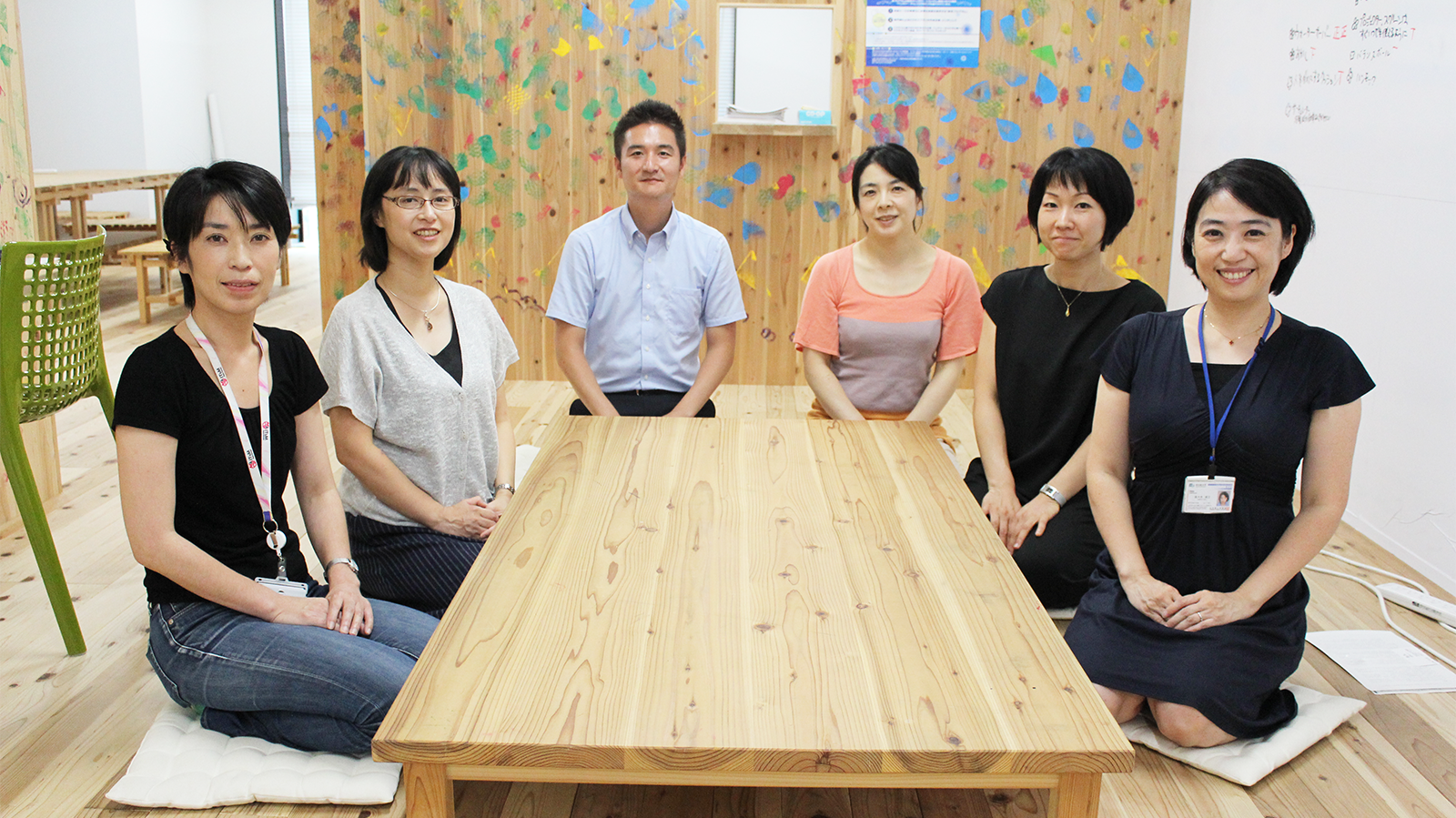
We had the opportunity to attend one of the community lunch meetings, during which we interviewed six of the community members.
The women spoke openly about their experiences as solo parents, their activities in the community, their private and professional lives, and their careers as women academics. We were certain that the initiatives of the women academics at Nagoya University will help invigorate Japanese academia.
All Those with Influenza Type A, Gather Together!

— How do members support one another?
[Narie] Someone sends an email saying, “What should I do about this problem?” and the other members reply. Each member will share their experience and off er advice, saying, “This is how we dealt with it in my case.”
[Miho] And then, we sometimes contact each other to arrange pickups for the children. Azusa, Noriko, and I have Grade 1 elementary school children, so we help out each other in the pick-ups and share our experience to a great extent.
[Noriko] Yes, it is important to keep in touch about each other’s children’s school situation.
[Azusa] An elementary school’s PTA is a minefield of tacit rules. This is my first child, so I had absolutely no idea what to expect at the school. Noriko is more experienced in this regard, so I seek her advice on various matters.
[Narie] It’s important to remember that we are not just a group of working mothers; we are university teachers as well. What makes our community such a great source of comfort is that when you have to work late because of a meeting or say other circumstances specific to the academic profession, you can be assured that the other members will understand your situation without you having to explain the details. If we were from different professions, we wouldn’t see eye to eye, and others could say, “Well, it’s different where I work.” You would just end up feeling exasperated.
[Azusa] Exactly. You can’t excuse yourself from your allocated lectures, and while there are some meetings you can avoid, there are others that you absolutely cannot. You see, this job has some unique features! (laughter)
[Narie] I’ll give another example, and this is interesting because it’s so typical of an academic. When there was an influenza outbreak, Miho sent a message saying, “My kid’s got a type A fl u virus. Do anyone else’s kids have type A fl u? Let’s take care of all those with type A flu together!” (laughter)Two people with the same type of influenza aren’t going to infect each other, right? So she said, “All those with type A gather together! All those with type B gather together!”
[Miho] Yes, I remember that. A small child gets sick so oft en. You get desperate because caring for a sick child prevents you from working. A male colleague, who doesn’t know a thing about parenting, one said,“Your child’s sick again? She seems to be sick all the time. Is everything okay?”(laughter)
[Noriko] I’ve received comments like that too! (laughter)
[Miho] I want to tell them that it is perfectly normal for children of that age to get sick frequently! (laughter) People with no experience of parenting don’t understand this.
―How did you fi nd out about the community?
[Ayae] When I accepted the job at Nagoya University, my eldest boy was two and the younger boy was nine months old. I had to live separately from my husband, and I was unsure whether it would be feasible to take such young children with me. But I then began to receive many emails from women academics in the same situation. They advised me on day-today matters and on where I should live. A professor contacted the Center for Gender Equality for me, and from there, I got in touch with the community. I was, therefore, able to take up my post with complete ease. And another thing—I now live in the same apartment house as Narie. It’s great to know that I’ve got someone close by to rely on.
―That must be reassuring.
[Ayae] I was also able to start my lab/office smoothly. If you want to advance to the next rung of the academic career ladder, you have to look for suitable posts all over the country. If you let an opportunity pass, it will be years before another comes along. However, what made me decide to accept a job at Nagoya University was the university’s excellent research environment.

The Importance of Family Support

―How did your respective husbands react?
[Ayae] My husband didn’t seem surprised or shocked. He asked me to be honest about what I wanted, and said that he would respect and support my choices. So I talked through my decision to take the job in Nagoya University. He works for a firm in Tokyo and he visits me in Nagoya on the weekends.
[Miho] My husband was supportive too. He told me that he would take care of the children if I wanted. I thought that it wouldn’t be feasible as my youngest was still breastfeeding. So I said that I would take the children. But his supportive attitude was a major factor in me deciding to take up the post.
―Do you know anyone who was unable to take an excellent job opportunity due to family commitments?
[Azusa] I know of quite a few women who limit their job search to Tokyo and its peripheries because their husbands insist that they live together. Granted, it might be nice for a family to live together under the same roof.
[Miho] When couples in academia stay together, the wife usually sacrifices a permanent position. Or she gets a non-academic job.
[Narie] Our members generally have very supportive husbands.
[Miho] My husband is an academic as well, but when he is home on the weekends, he takes charge of preparing meals, shopping, and looking after the children. Support from your husband and your parents/in-laws is essential to make solo parenting work. Living separately from your husband will only work out if everyone in the family is prepared to lend a hand in parenting.
[Azusa] My husband and Miho’s husband are friends. They get in touch on the weekends and take the kids out to play. Miho’s mother and mine became friends too recently. When the older generation becomes friends, it makes things even easier.
―So your parenting benefits from interfamily connections at three generational layers.

Subconscious Gender Bias

―Do you know of any male academics in your situation?
[Narie] It is extremely rare for a man to take the children and raise them as a solo parent. By the way, didn’t you leave your children with your husband, Keiko?
[Keiko] Yes. Since I moved out to take up my post, all the family members have helped one another. This has proved to be a growth opportunity for everyone concerned. That said, the burden on the family was greater than I expected, so our child came back to stay with me a couple of years later. At the time, my daughter was in the upper grade of elementary school. She told me that she didn’t want her friends knowing that I don’t live at the family home due to my work. She didn’t want her friends to think ill of the family. This hurt me deeply. Children have their own ideas and feelings, and it appeared that my daughter had internalized social norms about the family. This is one
of the issues we need to address if women’s social positions are to improve.
[Miho] I agree. Children suffer when they absorb social biases and begin to believe that their family is abnormal because the mother lives elsewhere. I had a similar experience when I didn’t participate in the nursery’s jumble sale. My daughter said to me, “Why didn’t you come? Everyone else’s mom came.”
[Azusa] I had this experience when I didn’t attend the school’s open day. My daughter asked me why I didn’t attend. I told her that I had my own classes to attend to. She then asked, “How come you attend someone else’s class but not mine?” (laughter)
[Miho] Me too. My daughter cried because I didn’t attend. But if Japan had more two-parent working households, then our children wouldn’t feel so marginalized; they would see that several other mothers don’t turn up to these events due to their work commitments.
[Narie] My daughter once told me that she envies children whose mothers stay at home. I said to her, “Yes, but just imagine what it would be like if I was at home all the ti me. Aft er you return home from school, I would constantly badger you about doing your homework. Would you like that?” My daughter said, “No way! It’s better that you keep working!” (laughter)
[Azusa] When children ask you about something they are curious about, the way you reply is all-important!
[Narie] I want children to think that working mothers are cool. Conversely, they should also think it odd if only the mother attends the PTA or only the mother packs their lunch; they should be thinking, “That kid’s got a weird family—the father never does these things.”

Misconceived “Career Support”

[Noriko] The existing system of career support for mothers seems outdated to address the real needs of present-day mothers. I gave birth and began childrearing when I was moving from one post to another as a post-doctorate researcher and corporate researcher. I was asked to leave my job because of my pregnancy. On the other hand, when I was raising my child, I was excused from certain duties at work and reallocated to an easier position, all in the name of employee welfare. I was unhappy about this. I wanted to pursue research and take on challenging work despite bringing up my child. I felt that working was futile if it brought me no job satisfaction.
[Narie] They transfer you to a position that’s cushy but dissatisfying. As well-meaning as this measure may be, it misses the mark for women who are devoted to their research and want to advance their careers.
[Noriko] Exactly. It offers no real benefit to those who need career support. In the name of career development, they promote you to a higher positi on and raise your salary, but all of this is meaningless if the work itself isn’t interesting. Dissatisfied with my job, I resolved to take a job at Nagoya University and to live separately from my husband with the kids.
―Did anyone in your family oppose your decision?
[Noriko] Actually, the offer from Nagoya University was the second offer I received where I had to decide if I wanted to take my kids and live separately from my husband. When the first offer came, my mother-in-law voiced opposition, so I gave up on the idea. But then I felt that I just couldn’t abandon the plan. I felt that I wouldn’t get another opportunity like this [referring to the second offer], so I tried to persuade her of the idea. My husband had earlier lived separately from the family home for his work, and I thought that it was strange that I alone should encounter opposition for doing the same thing. Living separately proved beneficial to the family too. Previously, my husband hardly ever left the house during the weekends. But I was pleasantly surprised to find that he has now started taking the kids swimming or to the park, and even started cooking meals.
[Narie] I guess that when you can’t see each other all the ti me, it makes you appreciate your family all the more.

Still a Surplus of Talented Women

―My company now has an 80% female workforce. It seems that women are more motivated than men and prioritize job satisfaction over pay.
[Azusa] In other words, there is a surplus of talented women. Of course, there are plenty of talented men as well, but there are even more talented women who are not used to their full potential. The organizations who can attract this talent will have a competitive advantage in the future.
[Narie] Men do not have the option to not work, so workplaces consist of both competent men and those who are not so competent. I say that the highly motivated women should be allowed to work to their full potential and that the unmotivated men should stay at home! (laughter)
[Miho] Several talented women spend all their ti me at home caring for their children. But it would benefit the children if these women leave their homes and use their talent
[Narie] When I returned to work two months after giving birth and sending my child to nursery, one of my students showed me his dissertation. It was a study in which mother mice were separated from their litters. The results indicated that a certain period of separation each day had a beneficial effect: the mother mice developed a closer relationship with their litters compared to other mother mice who had not been separated. So the student told me not to worry about living apart from my child because, after all, biological evidence proved its benefits. Sure enough, when I picked up my child from nursery, I found that she was even dearer to me compared to when I had dropped her off! (laughter)
[Miho] When you spend time apart from your child, it makes you value the time that you spend together all the more.
[Azusa] That’s right. There are all sorts of benefits.
[Narie] In the past, I was so overworked that I doubted whether I could really have a child. My supervisor patted me on the back, saying, “What are you saying? Of course, you can have a child! Children don’t belong to you; they belong to society. It’s wrong to think that you can bring up a child on your own.”
[Azusa] I know what you mean. I understood that parenting is something you do with the support of various people.
[Narie] True. The idea that you merely create a copy of yourself is disturbing to me. It is much better to think that many people help the child grow. At home, someone from the elderly employment center does all my housework and looks aft er my daughter when she returns home. You can solve parenting issues by creating a family for the child in the community.
[Miho] Children grow up on their own, don’t they? Leave them to it, and they will go further ahead.
[Narie] When I left my daughter to her own devices, she made marshmallows with her friend, and they sold them in the street. She was delighted when they sold marshmallows for 1 yen! (laughter)
[Azusa] 1 yen? That’s far too cheap! I wonder if the people who bought them felt awkward about eating them! (laughter)
[Narie] As parents, we would have surely put a stop to it if we were there, but they were so happy to have sold their marshmallow (laughter). You really have no idea what children are going to do next.
Money Matters: A Surprisingly Tough Problem

―Do you face any concerns that are particular specific to solo-parenting academics who are solo parents?
[Narie] One such problem is not having too much money to spare. Despite having a double income, we have to maintain two homes, and the transport costs for visiting each other are not small. Unlike companies, universities do not provide any allowance because they consider separate living arrangements as a matter of personal choice and convenience.
[Azusa] I figured out that I spent over a million yen on shinkansen trips in one year!
[Miho] I spent over two million yen! I have to arrange travel for two people: my mother, who comes to help me out, and my husband.
[Narie] When the child takes ill, I have to hire a babysitter or arrange for one of my parents to come over, which means shelling out some 10,000 yen in one day. This is why we are thinking about home-sharing options for academics in our situation.
―Home-sharing?
[Narie] All the women academics who are solo parents can rent an apartment in the same house. I feel we should all pitch in to rent an apartment that we can use as a shared space. We can then hire people from the nearby elderly employment center to look after the children and cook them meals. We can take turns to drop off and collect the children. After school, the children can come to the shared space and play and eat under the supervision of the people from the elderly employment center. Don’t you think that’s a great idea?
[Ayae] That would be wonderful!
[Miho] We can’t wait for the university to organize this; we have to do it ourselves.
[Narie] Exactly. My dream is for us to occupy one apartment aft er another until we have monopolized the entire building or our members! (laughter)
[Keiko] That’s a great idea! When your kids get older, you can then hand over the apartment to new mothers who are academics.
[Narie] That would be great! Even if you have only one child, you still have to spend energy and money for things like hiring a babysitter, picking up and dropping off the child, cleaning, cooking, and everything else. But if everyone lives in the same place, you can help each other out. I would like such a system.
No Limit to Bringing Your Child to Work!

―How oft en can you bring your child to your workplace?
[Miho] After I gave birth to my second daughter, I started guiding one of my graduate students in writing a dissertation. I gave verbal instructions while holding my newborn in my arms! (laughter) You can’t wait until the baby has grown up to resume your academic work. You have to constantly watch over and guide the student.
[Azusa] My husband and I bring our child to meetings of academic societies. We sit the child down on one of the seats in the lecture venue, and they listen to the lecture. Because the child watched me or my husband practicing the lecture at home, they interject at ti mes during the lecture, saying, “Wait, that’s different from what you said at home!” This causes some giggling in the audience. (laughter)
[Narie] You can usually bring a child to seminars too. I once worked at Ochanomizu Women’s University, and that was even more amazing; I could bring my child to student presentations and thesis screening sessions and question the students while breastfeeding! (laughter)
―You’d question the students while breastfeeding? How cool. Brave Ochanomizu University.
[Miho] I sometimes bring my older daughter to university meetings. Of course, there is also work that you can’t do with a child present: work requiring a lot of focus, writing papers, writing grant applications, and so on. So I try to finish all these in one batch when I leave
the children with my husband, and I prioritize my work. I then efficiently schedule all the tasks to fit in the ti me available for me.
[Narie] Anyway, the point is that you can bring your child to work ! (laughter) When you start doing so, you’ll be surprised at what you can accomplish. Also, when you see someone else bringing their child to work, it gives you confidence to do the same.
―So the more you take the plunge and bring your child to work, the more it helps others feel comfortable about doing the same?
[Azusa] We need to gradually change people’s perceptions. Even on my days off, I often bring my child to my lab/office. It benefits both of us; my child plays with my students and it gives me a chance to get some work done. Most of all though, I want my students—both men and women—to see me bring the child to work, and to think about its significance. If I can make some kind of impression, then it will help change things for the better.
[Keiko] Given that childbirth and parenting occupy so much of our time, we take longer to build a track record compared to our male counterparts. But I think we can catch up with and overtake men.
[Azusa] After all, we live longer than men.
[Narie] So you see, the most important thing is not to abandon your career. It’s fine to be a low-fl yer for a while, but you should never abandon it. I want more female and male students to see how we strive to keep up with our jobs and to make sure we don’t quit while taking care of our children. Many women worry about whether they can balance their academic work with their family lives. To these women, I want to say: No problem. Look at me—even I am doing it! (laughter)
An Inspiration for All Women in Nagoya University
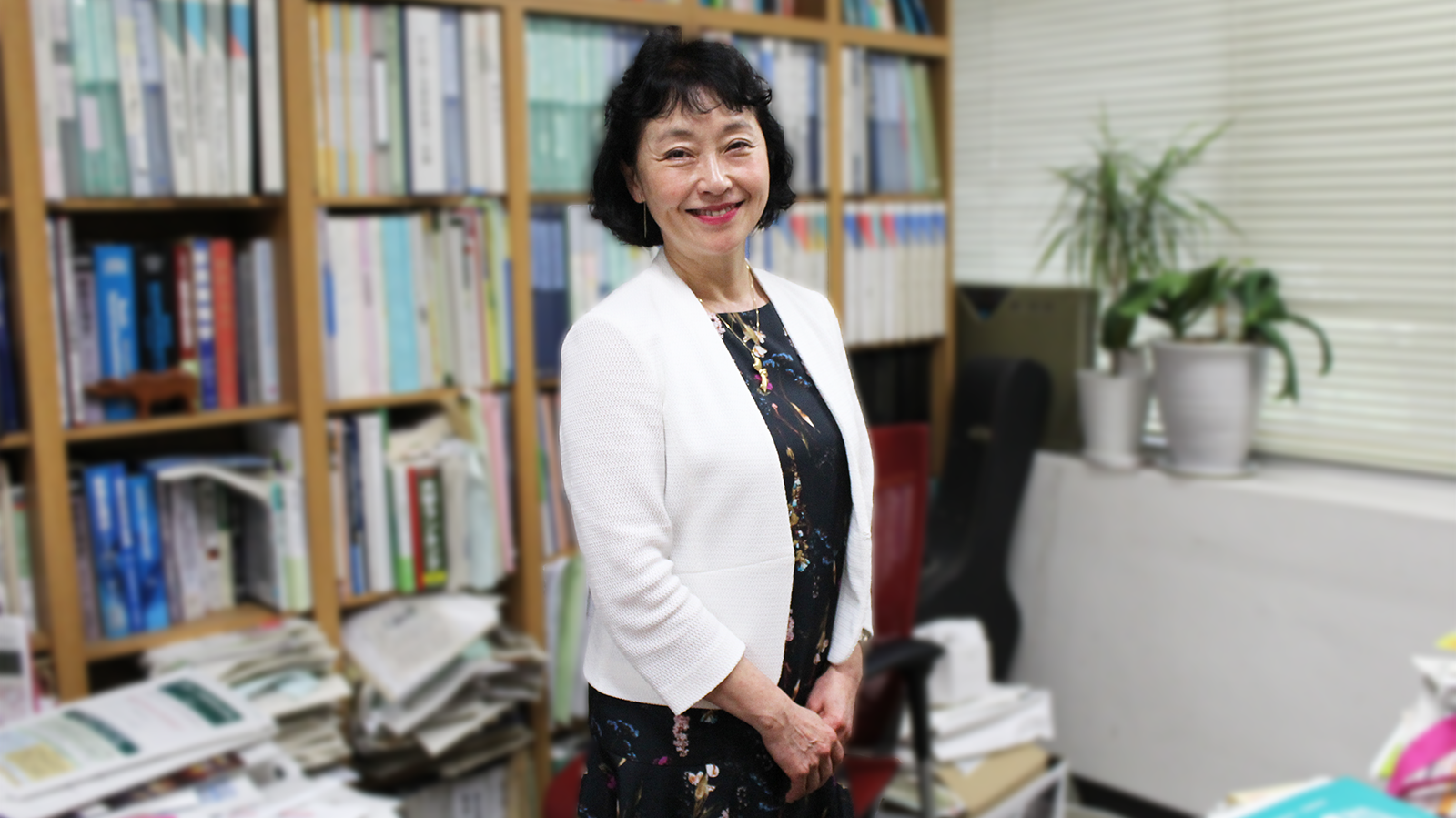
Here is the woman who started it all.
Hiroko Tsukamura started Nagoya University’s on-campus childcare facilities, and she made gender equality a key aspect of the university’s management strategy. The Nagoya University of today can be attributed to Hiroko’s efforts. She is an inspiration to fellow women academics. In this interview, she describes how to live positively, without yielding, when facing a career crisis.
Interviewer: Makoto Yuasa
Researchers’ Community for Child Care Support at Nagoya University: A Grassroots Initiative
[Makoto] The Researchers’ Community for Child Care Support seems unique.
[Hiroko] The most interesting fact about it is that it isn’t a university-led initiative; it was started following an initiative by the women themselves. Many women academics, upon accepting a university job, move away from their partner and take their children with them. Women who were in similar circumstances decided to form the community to support one another. I think this is praiseworthy.
[Makoto] Nagoya University is famous for the progress it has made in gender equality.
[Hiroko] Yes, the university’s gender equality efforts have a long history. After the Basic Act for Gender-Equal Society was enacted in 1999, the university wasted no time to establish a working group and began examining next steps. In 2002, the university was the first to establish the Center for Gender Equality (then known as the Office for Gender Equality). Since then, it has consistently strived for gender equality. During this period, it was selected for four MEXT funding programs for supporting women academics. The university makes efforts to support women staff. For example, the university has provided on-campus childcare facilities, including a nursery and after-school care. It has established a system for recruiting female principal investigators (known as the “framework for recruiting women professors and women assistant professors”). It also appoints assistants for women academics who are raising children. In 2015, the UN Women’s HeForShe Project selected Nagoya University as one of the top 10 universities contributing to gender equality.
A Support System that Includes Childcare Provision
[Makoto] It was your efforts that led to the establishment of an on-campus nursery and after-school care facility. What gave you the idea?
[Hiroko] Although everyone was voicing ideas of empowering women and people were organizing the odd event or discussion, everything was transitory. I wanted less talk and more action, and I wanted this action to result in something concrete. So, I started advocating the idea of demonstrating the university’s commitment to gender equality through something concrete. Initially, I thought about starting a nursery. That was the starting point.
[Makoto] Why a nursery?
[Hiroko] At the time, the campus already had a municipally licensed nursery. However, there were two problems with it. First, as a municipally licensed facility, it was only accessible to Nagoya city residents. If your address was outside Nagoya city or if you were a non-Japanese national on a short-term stay, you were not permitted to use the facility. Second, the women needed a nursery that was run more flexibly. For example, the nursery required parents to participate on weekend jumble sales and to contribute to the nursery’s management. The women, who were already too busy, wanted to use the nursery. But some would be put off by the extra work that this would entail. As a result, some mothers would hesitate about having a second child or even abandon the idea. So, I felt that it was necessary for the university to organize a nursery with a significantly higher level of freedom.
[Makoto] Carrying out your research, managing your classes, and providing constant care for a child as a solo parent—all of this means being incredibly busy, doesn’t it? How about the after-school facility? What was the inspiration behind that?
[Hiroko] The chances of women leaving academia are high not only when they give birth. In fact, a similar high attrition can be seen around the time the child enrolls in elementary school. This is known as the “Elementary grade 1 wall.” The nursery can offer extensive hours of care, up until 9 pm, if parents have an urgent situation to attend to. But once children enter elementary school, they come home early. This situation compels many mothers to think of quitting their careers. In an effort to overcome the “Elementary grade 1 wall,” we took the initiative to provide our own after-school facility. So, in a pioneering move for Japan—including the corporate/industrial sector—we voluntarily provided a facility with regular childcare services during weekdays.
[Makoto] That is amazing!
[Hiroko] When I thought of establishing the childcare facilities, I thought that I myself might use the facilities one day. However, I had to spend a lot of time and effort to convince people of the childcare facilities plan, and it took four-and-a-half years until the plan was realized. By then, I was too old to have children. The dilemma of whether to have children or pursue their careers is something that women continue to face alone. But I trust that we will reach a stage where women do not have to sacrifice their careers for the sake of their children. I don’t want any more women to undergo what I did. That is why I try to ensure that we do everything possible at the university level.

The Benefits of a Double Income
[Hiroko] People tend to see gender equality as a women’s issue, but this is a misconception. Society is beginning to question men’s working styles as well, and there is a growing understanding of LGBT. Gender equality means enjoying equal chances to work to your full potential regardless of your gender. I communicate this idea to a variety of people. In this case, for instance, since you are a man, it might make more sense to you if I explain it as follows. In the past, Nikkei surveyed male employees and asked them whether they can say “no” to their bosses. As many as 85% of the respondents answered that they could not refuse an order from their boss.
[Makoto] As many as 85%? That is a very distressing statistic.
[Hiroko] Isn’t it? But here’s the really interesting thing: If you just look at the responses from the men in their 40s whose partners also work, the results are reversed. More than 60% of these respondents answered that they can refuse their boss’s order. Do you understand the significance of this finding? How about you, Makoto? Does your partner work?
[Makoto] My wife left her job when we got married. She’s now a full-time mother to our two-year-old twins.
[Hiroko] So you are the sole income provider for your household. Have you ever experienced any difficulties because of this situation—monetary or otherwise? Do you ever worry, for instance, about how your family will cope if, God forbid, you suffer an unfortunate accident or become seriously ill?
[Makoto] I certainly do worry about that. Money is always a problem.
[Hiroko] Exactly. People tend to focus on women’s plight, but as you say, men are paying the price too. When men have to act as the sole breadwinner, they worry that if they lose their jobs, their families would become destitute. It is not surprising then that they are afraid to refuse their bosses. These men are forced to forsake a job that they would enjoy in favor of a job that delivers a stable paycheck. But then, there’s still the possibility of getting laid off or your company going bankrupt. In the worst case, you will have to sell the family home to pay off your debts and give whatever you have left to your wife who might ask for a divorce. Many men have experienced this. Doesn’t this possibility terrify you?
[Makoto] It is extremely horrifying! (laughter)
[Hiroko] Partners should respect each other’s lives and support each other, right? Suppose one spouse says to the other, “I want to quit my job because I’ve seen an opportunity to pursue my dream career.” If the relationship is healthy, the other spouse will offer support and encouragement. In such a relationship, you will be able to talk about your idea with your boss. The financial security of having both partners working also helps each partner value the other as responsible and independent adults. Then, when a baby comes along, if you use parental leave, you’ll still have 70% or 80% of the wife’s pay coming to the household. When I discuss the issue in these terms, men usually get it. You’re not going to convince men to get onboard if you merely lecture them about women’s empowerment. If men don’t recognize the issue as one that affects them personally, society will never change.
[Makoto] That is an interesting point. But even if husbands want their wives to work, there are still many women who choose to give up their jobs and become homemakers.
[Hiroko] Indeed. Money isn’t everything, and many women want to raise a child by themselves. There is nothing wrong with that. People should decide the course of their life. What I do insist upon is that women make an informed choice—they should understand the consequences of their decisions. Over the course of a lifetime, the difference between full-time and part-time work/flexible hours is as much as a hundred million yen. In other words, even if you have to pay for a babysitter for a while, you will more than compensate for it in the long run. Once you leave full-time work, it is very difficult to return. Therefore, the decision to leave work should not be taken lightly. Women need to know what they are choosing and its consequences.

Advice for Women Who Want to be Academics
[Makoto] When I walked into this office, I realized that you have many female students. There seem to be fewer women in the sciences though.
[Hiroko] I am shy of just 20 students, and 80% are women. I only have three male students. Two of them are overseas students, and one is a Japanese national. If you are a woman, you will feel much more comfortable joining an office or lab if many of your seniors there are also women.
[Makoto] 80% is a lot. Do you think that being a woman in academia is tough even today?
[Hiroko] Yes, I do. I, for one, had to struggle, and I know many women academics who are struggling right now. You might think that being a woman will make no difference, but when you actually start out in academia, it strikes you just how male-dominated it is. I realized that men’s attitude is problematic. Sure, some men might believe in women’s empowerment. But one issue that women face is that, since they are few in number, they stick out. Against this background, the more a woman devotes herself to her research and teaching, the more she will get attacked for being a woman. So, this is my advice to any woman who starts feeling victimized when she moves up the academic ladder: When someone starts attacking you, it means you’re doing it right. Your detractor is probably thinking that at this rate, you’ll rise to the top. If you didn’t have what it takes, nobody would be attacking you in this way. Of course, none of this is easy.
Toward a Future Where Ordinary Women can Succeed and Not Just “Superwomen”
[Makoto] How would you rate Nagoya University’s progress in gender equality on a scale of 100?
[Hiroko] It’s still at around 60. Women continue to be a minority. Currently, women account for 17.8% of the university staff. That said, in this regard, Nagoya is the best among the seven former imperial universities of Japan. Very few women occupy positions where they can make important decisions, but this issue is by no means confined to Nagoya University. This is an issue that needs to be addressed in all of Japan’s universities and in Japan’s corporate/industrial sector.
[Makoto] What can we do to increase the number of women in leadership positions?
[Hiroko] We need to get more ordinary women into leadership roles. Nowadays, the women who make it to the upper echelons of academia are all, as it were, superwomen. However, if you look at the male academics, you’ll find no shortage of plain, unremarkable individuals.
[Makoto] No doubt about that.
[Hiroko] Elsevier conducted a survey and found that women academics in Japan produce more research papers than their male counterparts do. Interestingly, it’s the opposite in other countries. This finding suggests that women only survive in academia if they produce exceptional results. Does that sound fair to you? Nagoya University is no exception; the women academics here are all bright, all of them stand out, all of them work very hard. But I worry that this sends out the wrong message; it tells women that to make it in academia, you have to be outstanding like these women. Women may end of thinking that unless they performed at an exceptional level, they’ll never cut it as an academic or that this not the life for them. I want academic careers to be accessible even to those women who are passionate about raising a family. However, these women face very big hurdles.
[Makoto] You’re a workaholic, aren’t you?
[Hiroko] I seem to give that impression, don’t I? But I don’t want to send the wrong message, so I make a point of leaving for home sooner than my students do, and I avoid sending emails late at night or on weekends. This applies even if I have to take work home with me. Regardless of how busy I get, I try to give the impression that I maintain a good work-life balance. After all, if I’m burned out, the young students won’t see me as a role model. When my students comment that I am busy, I refuse it outright!
[Makoto] “Workstyle reform” has become a popular expression in Japan. Do you think academics need to reform their working style too?
[Hiroko] Academia remains a male-dominated world, and silly attitudes continue to persist. Some believe, for instance, that since academics have to interact with people around the world, it is unacceptable for them to leave work at 6 pm or to have weekends off. Many do not think twice before holding a seminar on a weekend. This mindset must be changed. It excludes those who are raising a child for one, and in any case, don’t you think that such a working style would result in poor productivity in the long term? I believe that getting a greater number of women into academia will also improve productivity.

“Pessimism Comes from Our Passions; Optimism from Our Will”
[Makoto] What is the secret to your strength?
[Hiroko] I am a strong believer in positive thinking. According to the French philosopher Alain, “Pessimism comes from our passions; optimism from our will.” I have made this my motto. We will certainly have moments when we are down. However, regardless of how bad it gets, you can always learn something from the experience and transform it into something positive, even if it seems impossible to do so at the time. Similar to a compressed spring that bounces up upon release, the more the situation weighs you down, the more pent-up energy you have inside. You can then use this energy to propel yourself forward in life. When I experience some problem, I imagine viewing myself through the lens of a TV camera positioned diagonally upward from me. I thus try to view my situation as objectively as possible. We often regret a retort we make in the heat of the moment. On the other hand, isn’t it much more admirable when you respond to someone’s criticism stoically, admitting that you messed up and that you’ll do better next time? I try to respond as if I were playing a part in a movie, and behave in a cool, calm, and collected manner. What do you think?
[Makoto] That’s really cool.
[Hiroko] It is, isn’t it?
[Makoto] Hiroko Tsukamura, thank you very much. I feel like this conversation has given me an energy boost.
[Hiroko] That’s great to hear. You are not the first to say that! (laughter)
Interviewing the Key Person – How to Truly Support Women Academics in Their Parenting
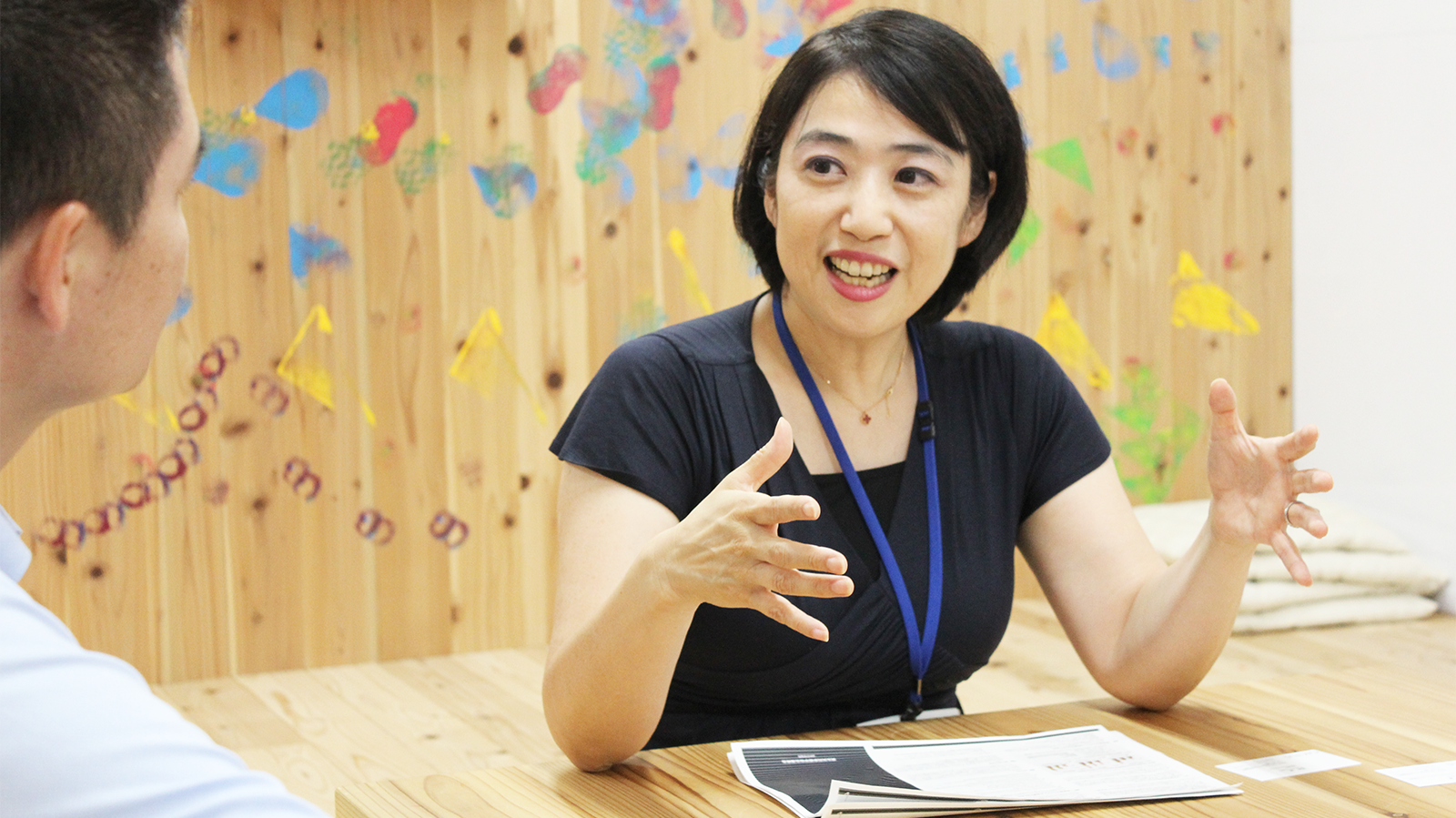
When we started covering this story, we soon realized that Narie Sasaki plays a key role in organizing holistic support for parenting academics at Nagoya University. Along with pursuing her biology research, Narie facilitates efforts to increase the number of women academics. She acts as an advisor who has first-hand experience of the issues and draws on her experiences as a teacher at Ochanomizu University and a member of Nagoya University’s Center for Gender Equality.
Launching On-Campus Childcare Facilities
I used to work at Ochanomizu University. My boss once said to me, “Narie, don’t you want to have children soon? It makes no sense that we don’t have any childcare facilities on the campus, so let’s start one!” I’d given up on having a child, but I closely witnessed how my senior colleagues were driving forward reforms to the parenting support system. I thought that, with this support, I might be able to have kids after all. I eventually had a baby a year after the nursery started and was able to make use of the nursery.
I came to Nagoya when my child was three. A friend told me that the real hardships come once the child starts elementary school and that I would need to use an after-school care facility. At the time, Nagoya University had a nursery owing to Professor Tsukamura’s efforts, but no after-school facility had been established.
So I thought, “Why not start one?” I had my experience at Ochanomizu University to rely upon, so I proposed the idea soon after I started working at the Center of Gender Equality. The first step was to find a suitable site. Fortunately, the university was planning to construct a new on-campus nursery, so I suggested making it a two-story building and including an after-school facility.
Have you heard of the “Elementary grade 1 wall”? You can leave your child in a nursery until late in the evening. However, elementary schools do not look after children during evening hours. So, once the child reaches elementary school, many women find that they can’t continue working. Nagoya University has taken steps to address this problem. With a single phone call, you can arrange for the facility to look after the child up to 9 pm. They can also give children supper and bathe them. They take care of everything my child needs!

Launching a Program to Recruit Female Principal Investigators
In an effort to increase the number of women in senior positions, Nagoya University launched a program to recruit female principal investigators. The first advertised vacancy under this program was filled by Azusa Kamikouchi, who came with her child.
A thought occurred to me when Azusa got the principal investigator job. To increase the number of women teachers, you need to be able to recognize talent and be willing to search extensively for the right person. We had been lacking in this regard. If you just limit your search to your own personal networks, you minimize your chances of recruiting a talented woman academic. If you are recruiting for assistant professorship, for instance, you might think that anyone could do the job. But if you create a woman-only position, your decision about who to recruit will have profound consequences for the entire department. Therefore, you need to be very judicious and ensure that the person you recruit is the right person for the job.
I realized that if the recruiters are more careful about recruiting the right person, it will lead to more talented women academics across the country. This experience was instrumental in the university realizing the importance of identifying the right human resources. Azusa took up her post at the age of 36, and she featured in Aera’s special feature on the “Top-100 people who will rebuild Japan.” She was also featured in
a journal of the Japan Science and Technology Agency. This approach also makes business sense; the university will subsidize, for a three-year period,
the personnel expenses of departments to recruit several fixed-term women staff. Against the background of staff cutbacks seen today, such an incentive is vital to motivate departments. When Azusa got the job, it helped encourage the mindset that it is advantageous to recruit women. Soon, several more women came to the university.
Nagoya University has the slogan “Helping women get to the top” on its application forms for major research grants. The government has praised the university’s efforts. Moreover, research grant aids are given relatively easily. Consequently, frontline professors who had never expressed a lot of interest in gender equality have begun to realize that this is an issue that concerns them as well. In addition to being a management strategy, it is also a strategy for improving the frontline situation. Nagoya University is unique for recognizing that recruiting more women benefits the university as well as the people at the frontlines by supporting research.

The Future of Efforts for Supporting Gender Equality and Mother Academics
In Japan, efforts to support gender equality are in their nascent stages. Nagoya University, despite all its progress, has only managed to increase the proportion of women staff by 1%. Effecting change is no easy task because the issue runs deeper than the university level; it is an issue that concerns society at large.
As I see it, the glass ceiling that women academics face is not so much an issue of gender as an issue of minorities. If you view it from the perspective of gender, the discussion risks being narrowed down to the biological differences between men and women. Such reductionism will dilute the real and crucial issue, which is figuring out how to increase the number of women academics and ensuring that talented women get appointed to influential positions. On the other hand, regardless of the extent to which women voice the injustices of the system, their concerns may get treated as an issue of minorities. Therefore, instead of focusing on reforming the system, we should first focus on recruiting a much larger number of women academics.
An economist once said that when you account for one-third of the whole, you’re on the threshold of not being a minority anymore. Although women would statistically continue to remain a minority, we would have reached a critical number and could start effecting change in the system. Once we reach the start line, the real issues concerning
women’s place in society will gain visibility.
The problems that the Researchers’ Community for Child Care Support endeavors to address are an increasingly important part of this struggle. Women academics who wish to prioritize their career will inevitably face the issue of having to live separately from their partner. People never really anticipate such a situation, do they? So a number of issues will come into focus, and we can address these one by one as they emerge.
The Researchers’ Community for Child Care Support is part of the broader effort to accelerate this process.


