What does it mean for a Researcher to be a Solo-Parent? A Reality Check
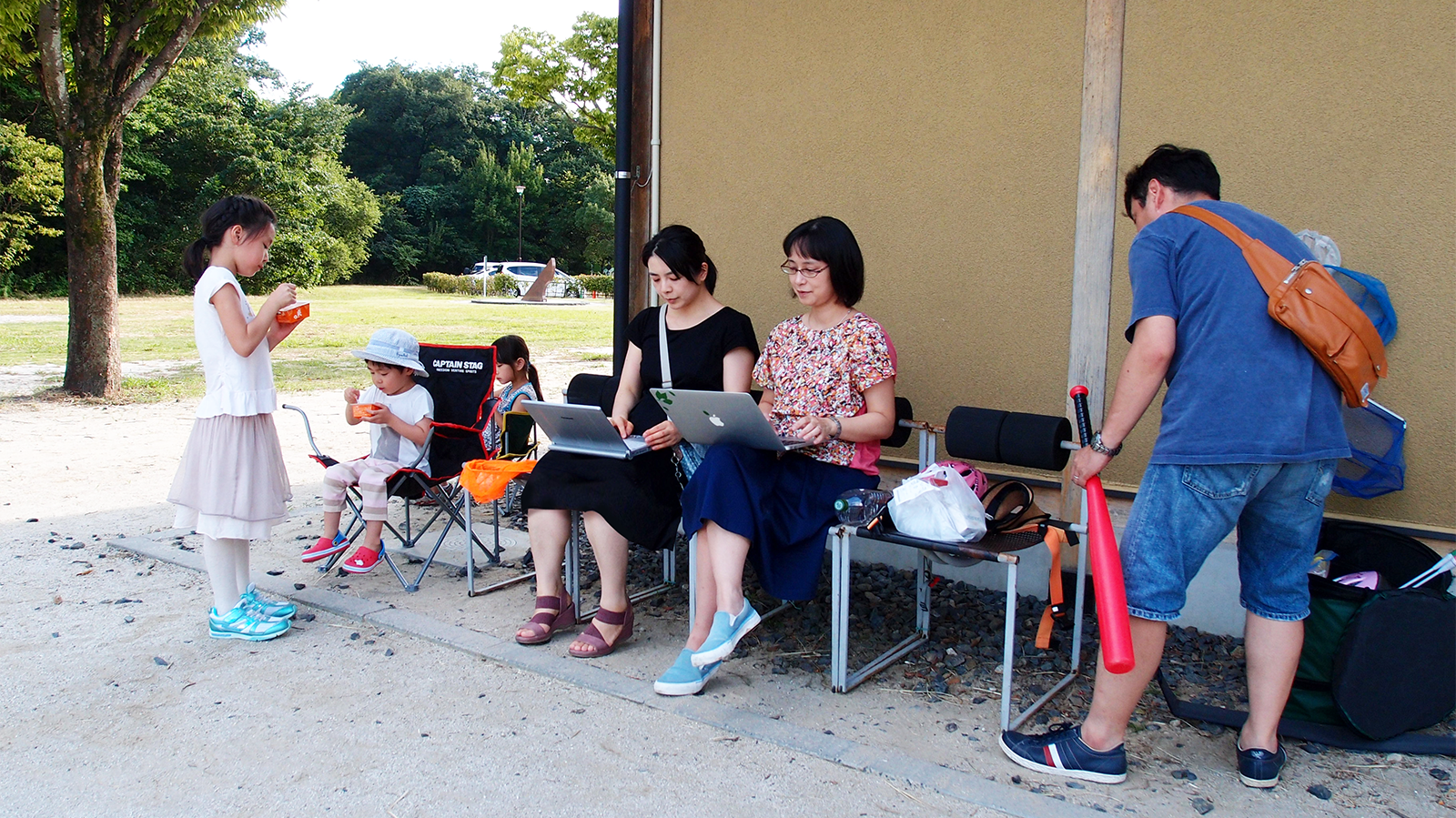
Interview with Miho Tagawa, Associate Professor, The Center for Integrated Research of Future Electronics
Upon accepting her post at Nagoya University, Professor Miho Tagawa relocated to Nagoya with her preschool daughter while expectant, leaving her husband behind to continue his work in a U.S. research institute. While raising her daughter solo, she gave birth to her second child. Like a hero, Miho returned to work before her newborn was even enrolled in a nursery. Despite the exhausting days and sleepless nights of juggling solo-parenting with work, Miho was determined to continue her academic career. This determination reflected her sense of duty, making her a role model for women academics, who she believes hold the key to Japan’s future.
If you don’t want to give up your career, you must live separately.
Upon accepti ng my post at Nagoya University in 2012, I had to move away from my husband with my young daughter. Previously, my husband and I worked at a U.S. research insti tute. My husband currently works at a research insti tute in Japan in a diff erent prefecture from me. Because academic positi ons are limited in Japan, one has to consider off ers from all parts of the country. This means that couples have litt le chance of getti ng jobs at the same university. Usually, it is the wife who gives up her career and follows her husband, either pursuing a post-doctorate or working a part-ti me job. However, all the women in our community were unwilling to sacrifi ce their careers in this manner. Couples in academia today inevitably face the following dilemma: if both parti es are unwilling to sacrifi ce their careers, they must live separately from each other. I was adamant that I would not abandon my career. This meant living separately from my husband.
A Week to Get Used to Being a Mother and Being Irreplaceable
When I took up my post at Nagoya University, I had recently become pregnant with my second child. Initi ally, I did all the domesti c chores alone with the baby inside me, and I sent my daughter to a nursery so that I could conti nue my research work. My husband was working at a U.S. research insti tute. Although he spent a few days with me aft er the baby was born, I had to parent alone aft er he left . It was unbelievably tough. Within a week aft er my second child was born, I was already back to work. What made it even more tough was something that is probably specifi c only to university staff : there is no one who can fi ll in for you at work. In parti cular, guiding the students in their undergraduate dissertati ons and master’s degree theses requires specialist experti se, and I was the only one who could perform these tasks. Legally speaking, I was on maternity leave and permitt ed to not return to work formally for at least two months. However, during this ti me, I guided students in their dissertati ons or other tasks while taking care of the baby. So I was doing all this work while simultaneously acti ng as the solo parent of a newborn and a two-and-a-half-year-old. It was absolute hell! (laughter)

Meeting Others with the Same Experience and Forming the Community
When my second child was born, there was no one I could call for help. The sleepless nights and the pressures of my job had brought me to the brink of insanity. It was then that I met Azusa and Hiroko at Nagoya University. Like me, they were raising children on their own while living away from their husbands. The three of us would meet up for lunch. As we chatt ed, I realized that the three of us were going through the same thing. Our rapport comforted me and made the hardship more tolerable. We then resolved to help one another in ti mes of crisis and that was how our community began—from a small three-person group. Soon aft er, we learned that there were other women academics who shared our circumstances. Upon investigati ng, we learned that around ten such women were on campus and that they were all struggling to cope. So, we invited all these women to lunch. That lunch meeti ng led naturally to our community being formed. As all our members are too busy anyway, we do not organize any parti cular acti viti es; we simply have a mailing list. Our members can use this mailing list to invite the others to a lunchti me chat or to ask questi ons about parenti ng. Oft en, someone sends a mail saying something like the following: “Because I don’t have ti me to prepare a meal, I want to eat in the university canteen with my child. Could someone accompany us?” Then, another member responds saying, “Sure! I’ll come!” Eati ng lunch in the canteen with two small children is a very big challenge! When you are feeding one of the children, the other might say, “I want to go to the toilet!” But when you go to the canteen with another parent who, like you, has two children, it is signifi cantly easier to take care of the four children between the two of you.
More Stressful than Work: The Social Expectati ons of Motherhood
The most diffi cult aspect of working while solo-parenti ng was not work pressure. The psychological pressures of motherhood that I felt during school PTA, nursery parents’ meeti ngs, and the like were more diffi cult to handle. For example, Japan’s licensed nurseries disregard the needs of single-parent families; PTA meeti ngs and event planning are held on weekday evenings. It is assumed that mothers who att end these meeti ngs have the opti on to leave their children with their husband or parents/in-laws. Single parents, however, must leave their children at the nursery during the meeti ngs and then collect them aft er the meeti ng ends late in the evening. As a result, the child might start going to bed later. This results in the child feeling ti red in the morning, creati ng a vicious circle. It is a social norm that mothers should att end the PTA and nursery parents’ meeti ngs. Single fathers, for unknown reasons, are let off enti rely from PTA duti es. One ti me, when my husband, who had come over for a weekend, parti cipated in the cooking at a nursery parents’ meeti ng fair instead of me. The other mothers criti cized me for this. I told them that I had been unable to att end the event due to work commitments, but they were indignant, saying, “Well, all of us have sacrifi ced our careers for our children.” As someone who was raising children alone while working just as hard as my male counterparts or even more, I couldn’t accept this atti tude. With this mindset, society will always exclude women who want to pursue a career. Fortunately, there is an on-campus nursery. In my case, however, I couldn’t enroll my child because the ti ming wasn’t right. The great thing about this nursery is that all the parents are involved in the university and the nursery doesn’t organize acti viti es that require parent parti cipati on.

Why I batt led on as a Solo Parent
I conti nued to pursue my career owing to my passion for academics, but that was by no means the only factor. I also felt a sense of duty as a woman academic. I thought about the message I would send to the next generati on of women if I quit now. It’s not that an academic job is bett er than other jobs in terms of pay or employment conditi ons. With the same academic qualifi cati ons, you could get a job in the corporate sector with bett er conditi ons. My university job entails plenty of overti me. This is parti cularly true during the entrance examinati on season. Because I fi nish work late every day, I would have to leave my child with my husband in Tokyo, and then aft er fi nishing a day of hard-work, I would go to Tokyo to bring my child with me. I would receive an allowance for handling entrance exam-related work, but this didn’t even cover the transport costs; I had to make up for the shortf all myself! (laughter) Financially speaking, it would have made more sense to fi nd another job that would allow me to conti nue living with my husband; we would have been bett er off this way. Despite everything, I was determined to sti ck by my career. I was driven in large part by a sense of duty; unless more women pursue their academic careers, the country would have no future. It was surely the same for the other members. All of us had a strong convicti on that we should commit to our academic careers and pave the way for future women academics. While working for an insti tute in New York State, I noti ced that 40% of the people there were women, and yes, many of them were raising children. The climate was completely diff erent. The truth is that the issue extends beyond Nagoya University or beyond universiti es in general; we have to reform the country as a whole.
The Signifi cance of Forming a Self-Help Group
I believe that we—the women academics—should take the initi ati ve to support ourselves to the extent possible. Public funding for universiti es declines annually, so we cannot overly rely on subsidized programs. One of our key acti viti es is to help women academics who have newly started work at the university fi nd suitable accommodati on. For example, a member might noti fy the person of a vacant apartment in her apartment house. This is becoming one of the important types of support provided by this community. As a result, we now have an apartment house let out only to women academics working at Nagoya University. If this were to be a university-led acti vity, meaning that if the university were to provide accommodati on for solo mothers, it would fi rst have to secure a budget. By the ti me the accommodati on is fi nally provided, the children would have already grown up. That’s why we prefer to take acti on ourselves. Using word-of-mouth networking, we aim to secure places where we can live communally; we fi nd a place and say, “Let’s monopolize this place for our members!”

Women’s Academic Careers in a Male-Dominated Society
The academic world has unspoken rules governing the age at which you ascend each rung of the career ladder. Fail to sti ck to these rules, and you can never get back on the ladder. I would argue that women academics are somewhat disadvantaged by this system. It would help if more male academics in senior positions had parenting experience. If chief researchers or faculty directors have childrearing experience, for instance, they will understand the challenges of parenting and think more about ways to assist the careers of ti me-deprived academics. We have our own ideas about how we could get a lot more work done, but we can hardly talk about this issue with them.
The Academic Benefits of Parenting
The academic world has unspoken rules governing the age at which you ascend each rung of the caree Someti mes, the journey home from the nursery takes a while. For example, one day, I was heading back on my bicycle with my daughter riding with me. As we passed by the shrubberies around the School of Agricultural Sciences, I pointed out how prett y the moon looks to my child. Aft er we left the grounds, she asked me whether the moon in the sky was the same as the one she had seen before. “It’s the same one,” I told her. “No, it looks diff erent,” she replied. So we stopped and went back to the shrubberies to compare the two moons. Carrying on thus, it felt like we would never make it back home! (laughter) Children are inquisiti ve creatures. They feel curious about several things, so adults get bombarded with all sorts of questi ons. Children are natural scienti sts, aren’t they? It’s great fun to spend ti me with your child thinking about why certain things are the way they are, and as an academic, there is so much you can learn from your child. Moreover, children with a parent in academia will encounter science from an early age. The parent and child can both learn from each other.

What was the Inspiration Behind the Researchers’ Community for Child Care Support at Nagoya University?
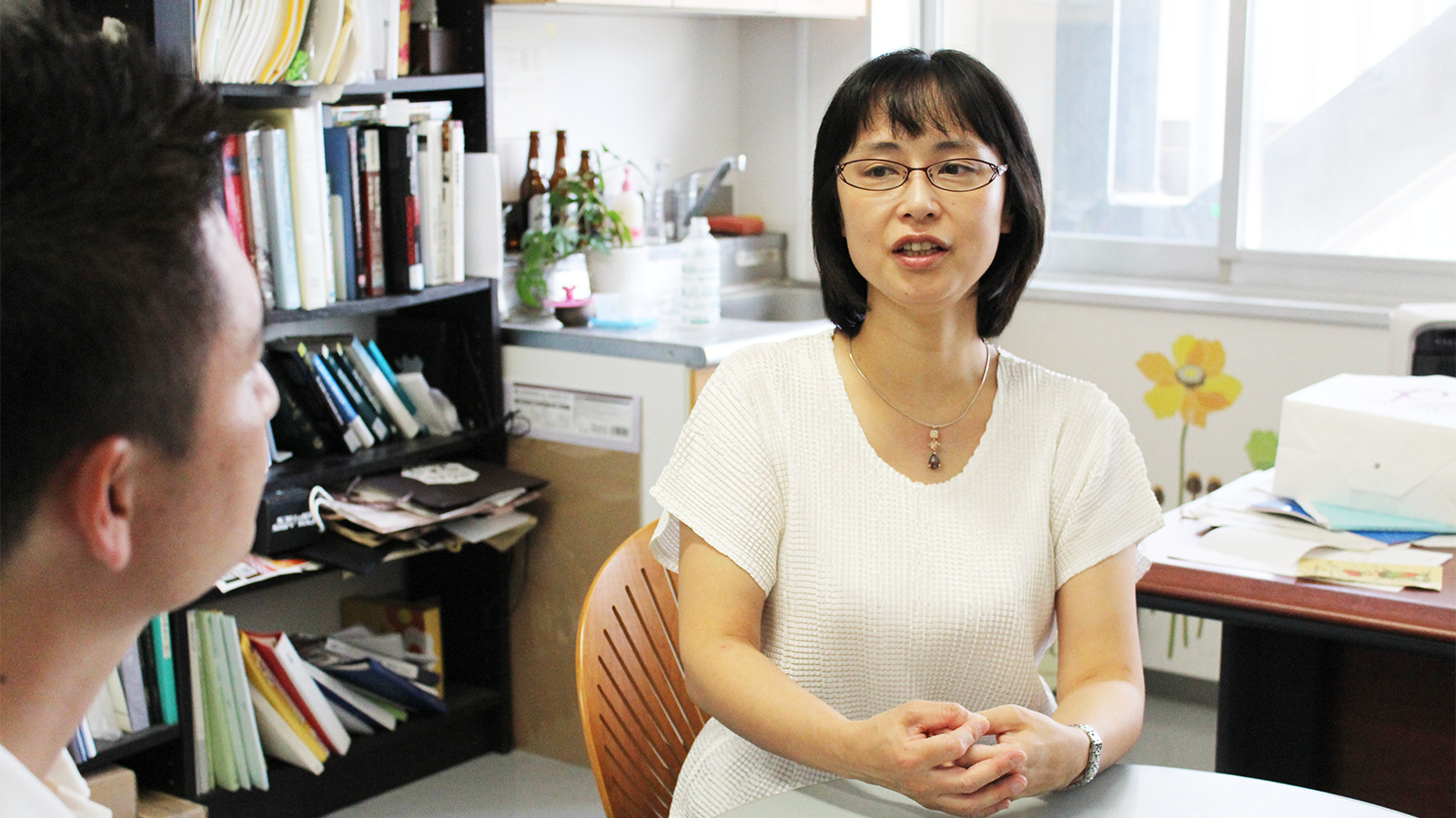
Following Nagoya University’s publicly advertised recruitment drive for female principal investigators, Professor Azusa Kamikouchi took up her post at the university in 2011 at the age of 36. Professor Kamikouchi has achieved renown as a female proponent of science in Japan. The Japanese weekly magazine Aera chose her for the science category in its 2012 “Top-100 people who will rebuild Japan.” It is remarkable to think that such a noted academic arrived at her post in Nagoya University as the sole parent of an infant.
Professor Kamikouchi witnessed how the university’s support measures failed to cover the needs of academics whose job compelled them to live separately from their partner and raise their children alone. She felt that if no support was forthcoming, then fellow academics with similar circumstances should support each other. This idea was the spark that gave rise to the community.

“When I got the job at Nagoya University, I moved to Nagoya with my child and my mother. Initially, I struggled to balance the responsibilities of getting the lab up and running and taking care of my child. However, I didn’t have to suffer in silence. Even before taking up the post, I discussed my accommodation and childcare needs with Narie Sasaki from the Center for Gender Equality. I felt very grateful to have a senior figure with whom I could discuss my concerns. After taking up the post, I became increasingly aware of people in the same situation as me—women professors who had to raise children by themselves. Initially, I exchanged information on parenting with two other academics: Miho Tagawa, who works in engineering, and Hiroko Bannai, who has since moved to another university. However, Narie suggested that we expand our three-person group into a university-wide network. That way, she said, we could obtain a lot more information and provide support to many more people. We decided to take up her suggestion. We launched a website and spread the word among the academics with children who we met at a nursery. The community now consists of more than 10 members who share useful information with each other.”
The community is based on a single mailing list. This simple structure is important. Members seek help and advice on the problems they face, and other members respond. Because the members are academics with busy schedules, it makes perfect sense to adopt this simple structure of mutual support and reduce unnecessary processes.
“We advise each other on the best clinics or hospitals to visit, ask each other to drop off or collect our children, and babysit for each other. There are times when we realize that we need to do some things as a group and decide to get together. When an academic is about to take up a position at the university, we sometimes advise her to rent an apartment close to where the other members live. No one acts as the leader. Instead, members lend a hand when they are free.”

Nagoya University is noted for having a relatively advanced childcare support system. According to Professor Kamikouchi, the university’s official support system and the community’s self-led efforts complement each other. “One advantage of a university-led childcare support program is that you can prepare budgets and projects on a grand scale. On the flipside, it takes time for these projects to be implemented. As for our network, we can’t spend a lot on our activities, but when fellow members are in their most desperate need, we can respond much more precisely and competently. We make decisions quickly, and when someone is in trouble, we rush to their aid promptly. Both have their own merits. When there is close communication between the university-level support teams and the individuals concerned at the grassroots level, comprehensive and integrated support is possible. The Center for Gender Equality has proved to be an enormous source of support to us. It has also referred new solo-parenting university employees to our community,” says Professor Kamikouchi.
We asked Professor Kamikouchi what her advice would be to people in other universities who want to create a similar community.
“The first thing to do is to form a group of three. With a group of three people who share common interests, you have all you need to start a network. So when you meet two other people with common interests, that’s your opportunity. Once we started our network, other people found out about us and realized the value of our activities. As more and more people started praising our efforts, I began to get a sense that our community was gradually making progress.”
The Work of a University In-house Designer
“Design is not just what it looks like and feels like. Design is how it works.” Steve Jobs said this in the context of the iconic Apple products. Design in research and public relations is an important and indispensable function for communicating to lay people something technical and possibly difficult to understand in any other format.
University in-house designer
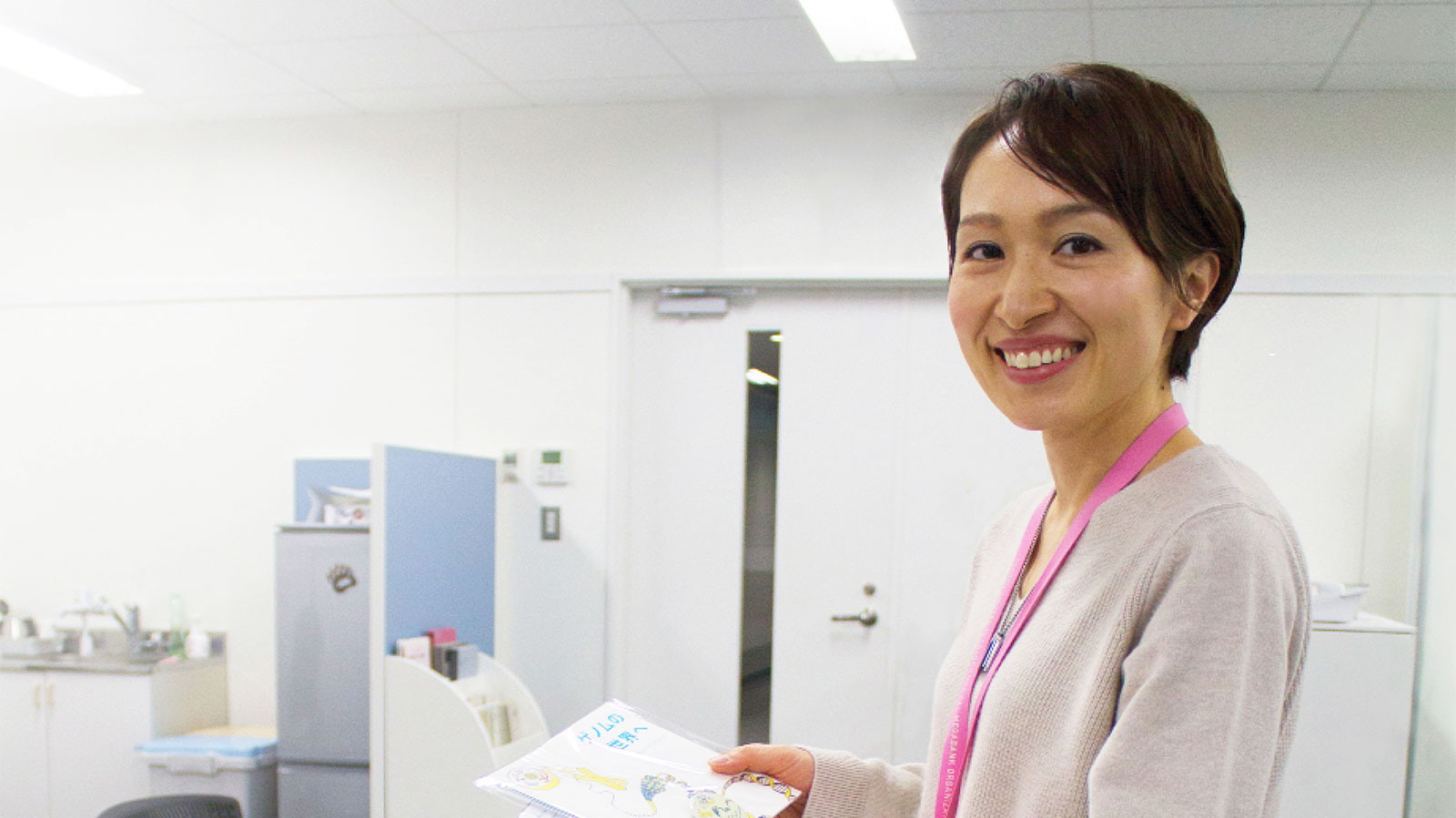
We interviewed Miho Kuriki who is in this unique profession as a specially appointed assistant professor (PR) at the PR strategy office of Tohoku University’s Tohoku Medical Megabank Organization.
Recipient of the Good Design Award 2014 – Pathbreaking design in the Tohoku Medical Megabank Organization’s PR strategy team


There are not many research institutions producing as much publicity material. The photo above shows a selection of countless designed materials, including everything from typical items such as PR magazines and email newsletters to staff t-shirts for events, postcards, badges and bookmarks along with all sorts of publicity & educational pamphlets.
Particularly of note is the monochrome pamphlet (01) for its barrier-free design that makes it easily readable to the colorblind. Winning the Good Design Award in 2014 became a major topic of conversation. Miho Kuriki often applies the idea of “making something of great public interest that serves as a conversation starter” into her design.
Not many research institutions produce as much publicity material. The photos above show a selection of countless designed materials, including everything from standard items such as PR magazines and email newsletters to staff t-shirts for events, postcards, badges, and bookmarks along with all sorts of publicity and educational pamphlets.
Of note is the monochrome pamphlet (01) for its border-free design that makes it easy to read for the colorblind. Winning the Good Design Award in 2014 became a major topic of conversation. Miho Kuriki often applies to her design the idea of making something of great public interest that serves as a conversation starter.
In-house design: Creative work that stems from the desire to make something new right from conception.
When producing a design in-house, you think about aspects like why, what, for whom, and how you are creating the project from the conception stage onwards, and this allows you to give shape to ideas. On the other hand, when it comes to outsourced design – and this is regardless of whether the publicity materials are for a university or research institution – the product, content, and even the text to be used has often already been decided before the order is made, which can result in the company being bound by the text to the point where the visual aesthetic of the piece is limited.
There are times when the organization director will provide a specific theme at the conception stage, and there are times when the parties collaborate from the very beginning with the intention of coming up with something brand new. The department head and designers work together to come up with new ideas and they adapt as they create; in most cases, it takes about three weeks from product planning to completion. This sense of speed and deftness could be due to it being an in-house communications team.

- Brainstorming with chief Nagami about concept of the new products. Narrowing down the purpose and target, layout, illustrations, and designs to be created, and printing paper.

2. Designing using an iMac. “Most of my work, which is creating design, is done quietly and I take my time.”

Powerful and speedy collaborations between the communications director and the designers to keep up with the new

Before coming to Tohoku University, Miho Kuriki worked as a designer at an advertising agency in Sendai city and in a museum doing PR. At a time when she was looking to change jobs out of her desire to focus on design work, she came across a design position through Hello Work for the PR team of Tohoku University’s Neuroscience Global COE. According to Miho, “I was interested to see what design work for the sciences at a university would be like. Having designed for the School of Medicine for five years, I am now moving to the Tohoku Medical Megabank Organization.” You may be tempted to think that some scientific understanding is necessary to work full-time on design for the sciences, but it is the very lack of that knowledge that allows you to take on design challenges with unrestricted creativity.
Miho says, “At first, I had no interest in neuroscience or genes, and I had no idea about the design concepts I was asked to work on. But having worked in design at Tohoku University for ten years now, I think that I have gradually become used to scientific communications.” She talks about her illustration depicting the sharing of genome data, one of the concepts from the Tohoku Medical Megabank Organization. The group leader, Fuji Nagami, came to her with the specific idea to have an image demonstrating genetic information being shared between people by showing a group of people reading a large book with an ATGC cell array written on it. The job of providing clear direction in scientific design and of being able to put that design into an appealing form requires a high level of skill.
What is the appeal of working as an in-house designer at a university? Miho says, “It’s the sense of speed. I find it interesting to make these various products one after the other at such speed. The organization’s projects are so varied that each day brings new experiences, from events to creating massive panels. I can’t think of any other workplace that changes so much.” Perhaps that sense of speed and change could be rare for a university. In any case, when it comes to PR that functions well and produces results– regardless of whether your team is in-house or not – the essential thing is to have strong designers who share the same aims and concepts and create dynamic designs.
That guy, the magic man
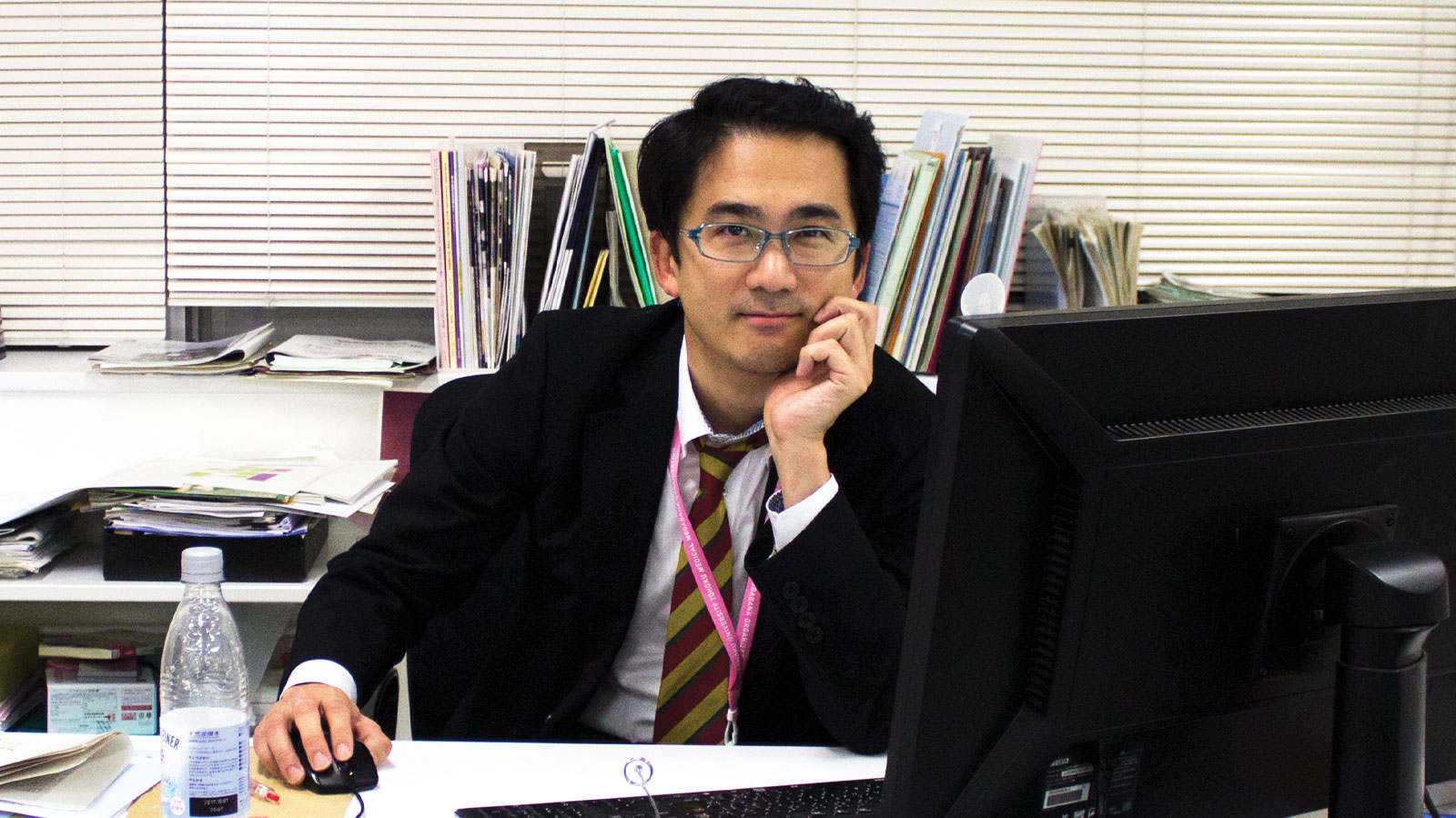
Meet Fuji Nagami, the research communications magic man who launched Science Agora and laid the foundations of science communication in Japan. Where did this PR professional, whose life’s work is to tell others about why research is interesting, end up after the earthquake?
Mr. Fuji Nagami
Specially Appointed Professor (PR) at Tohoku University’s Tohoku Medical Megabank Organization, Group Leader of Public Relations.
Interviewer Makoto Yuasa
From Science Agora to Tohoku University – Becoming a Scientific Communications Professional
[Makoto] Fuji, it was you who gave life to the large-scale JST (The Japan Science and Technology Agency) project, Science Agora. These days you can be found in the PR strategy team at Tohoku University’s Tohoku Medical Megabank Organization, but can you tell us how you ended up becoming a science communicator?
[Fuji] I attended graduate school at Tohoku University until the end of the program but left without graduating. I had joined graduate school thinking that I would become an academic, but when I was exploring new themes, I discovered that I was much better at discussing and hosting meetings to discuss research than actually conducting it. I thought that maybe my path could be to inform others why research is interesting, so I joined the Miraikan Museum which had then just opened. At the time I was just doing something I loved. I wasn’t even aware of the term “science communication.” At some point, people started telling me that what I was doing was science communication in Japan. I led Science Agora for just under two years after its launch. Just when I was getting to a stage where I wanted to do something new, I was approached by Noriko Osumi of Tohoku University, who asked if I wanted to be part of the PR team for a new neuroscience project at the university’s School of Medicine.
In the shoes of someone who witnessed the earthquake
[Fuji] After the earthquake hit in March 2011, we were able to post from Tohoku University School of Medicine’s Twitter account the next day. I think we were the fastest academic institution to post. When earthquakes happen, everything, from websites to emails, stops working. But Twitter functions even in times of a disaster. Once things had calmed down and it became necessary to start thinking about recovery, we gathered ideas from the professors and associate professors and it was out of this process that the vision for the Tohoku Medical Megabank Organization developed, and I became involved in its launch.
[Makoto] Do you think that the earthquake has had quite a big impact on both your life and your work?
[Fuji] Yes, I do. When you consider how recovery can be achieved and the role of the university in recovery, you will know that things take time because universities are places of human development and research. When we launched the “Cohort Study” project to help with the recovery, I knew that it would take five to ten years or even longer, and I thought it was an initiative worth spending time on. I think this is linked to being in the shoes of someone who happened to be at Tohoku University and witnessed the earthquake.
[Makoto] After moving from JST to Tohoku University, have you found any difference in the nature of your work as a science communicator?
[Fuji] Almost everybody living in Tohoku knows about Tohoku University. This means that PR work at a national university isn’t so much about increasing recognition as it is about branding. My job is to think about getting the university’s research presence into the local community and the local media and what sort of a branding image to create.
[Makoto] One way in which it is different from typical science communication is that the Tohoku Medical Megabank Organization has the specific goal of getting local citizens to be part of the cohort.
[Fuji] That’s right. The way PR is done at Tohoku University as well as in the School of Medicine or the Tohoku Medical Megabank Organization is different in other ways as well. After the earthquake, I was put in charge of PR for the Tohoku Medical Megabank Organization and the way I approached science communication changed. A major part of my work until that point had been using a wide platform to share why research is interesting and important; however, once I got involved with the large-scale cohort study research project, I started focusing on getting messages across to, as well as consulting with, large numbers of the public, including groups who opposed what we were doing. This made the meaning of the work more specific and pressing. Now, my work is more about communication and has a clearly understood target with visible results, which has made it a more challenging job for me.

What goes into university PR
[Makoto] I get the impression that the Tohoku Medical Megabank Organization is quite unique in its PR work but could you briefly explain what a PR specialist does?
[Fuji] When I came to Tohoku University and was working on PR for the neuroscience project, one day Professor Osumi asked me what I thought about an idea for an event whose title was a wordplay on the Noh theater and nō, the Japanese word for “brain.”
[Makoto] Ha, a great pun (laughs).
[Fuji] Oh, yes. It might seem as if there is not much in common between neuroscience and Noh theater, but I had been given a job to do, so I had to make the event work. My job began with a search for neuroscientists and noh players who would be willing to get onboard with this bizarre concept. There has always been an element of “anything goes” from the beginning, but the goal at the Tohoku Medical Megabank Organization, where I hold my current PR position, was to create a cohort of 150,000 people. This meant that everyone—from the 150,000 participants to their family and friends in the prefecture—would be stakeholders. For PR to reach everyone in the prefecture, you’re going to need to use all channels available.
[Makoto] Use all the media that can be used.
[Fuji] For example, when Pokémon GO caught everyone’s attention, some universities went so far as to get rid of any PokéSpots on their campuses, whereas we immediately decided to build a signboard in the organization building for all the PokéSpots. This is the way we think in PR. We also collaborated with people from the Vegalta Sendai soccer team to hold child-friendly events on campus grounds and we also held a lottery at the playgrounds.
[Makoto] You guys will really do and go anywhere for your PR work.
[Fuji] That’s right. We will go anywhere if we get the opportunity to explain what we are doing or to have our work seen by people who haven’t laid eyes on it before. Our PR project includes taking photos, creating boards or panels to be used on campus, publishing a PR magazine, making websites, television commercials, appearing on radio, advertising in newspapers, and distributing letters to each of the individuals participating in the cohort. I guess the work we do is similar to that of an advertising agency.
[Makoto] Have you had many groups come to observe what you are doing at the organization?
[Fuji] Each year we have at least 120 groups coming to tour the organization. Visits are our biggest PR activity. We invite groups who want to observe and learn about the organization, and most of the people who accept our hospitality become our supporters.
[Makoto] I see. But if more than 120 groups come to tour, then, by my calculations, that must mean you get at least two groups coming each week. Do you never get complaints from the PR team or the researchers at your organization about how these visits cut down on their research time?
[Fuji] No, never. Director Yamamoto has made it clear to the organization that any request to tour the organization should not be turned down. He explained that the building of the facility was funded by Japanese taxpayers, so it’s only fair for the organization to receive and politely respond to anyone interested in a tour. Likewise, it is imperative that this is understood from the onset as part of the organization’s mission. I, too, agree completely. Nobody complains because it’s part of our job.
[Makoto] It works because the people at the top share their vision with each individual member of the staff.
The Tohoku spirit witnessed in the earthquake support given to Kumamoto University
[Makoto] When the earthquake hit Kumamoto and Kumamoto University was in a bad state, you asked me to work with the volunteers. We divided a message about the emergency situation at Kumamoto University for people at Tohoku University to translate so it could be sent out in English, and I proofread the English translation. Why was there such a rush to help the people at Tohoku University?
[Fuji] Whenever there’s an earthquake, there isn’t much time to create a multi-language response. So, I emailed the academics at the organization to ask them to translate the details pertaining to the damage in Kumamoto. Academics tend to be proficient in English, so I split the text into parts and sent it in the evening to at least ten people. The translated text quickly took shape as the night proceeded to the point where the next morning, the people who hadn’t checked their emails were annoyed because they weren’t able to help out (laughs).
[Makoto] That’s some quick work.
[Fuji] The people of Tohoku were helped out by many different people at the time of the earthquake, so I think they felt compelled to help when something was happening elsewhere. As far as I can tell, there is nobody at the organization who would say no when asked.
[Makoto] We also learned that we can put our skills and the work we do every day to use at times of a disaster or emergency. That experience helped me realize the importance of being more proactive with pro bono translation and proofreading so that information can get to the people who need it.
The future of PR at the Tohoku Medical Megabank Organization
[Makoto] The organization has met its target of recruiting 150,000 members of the community into the cohort. What will the next PR goal be?
[Fuji] Behind the 150,000 who joined the cohort are prefectural residents who didn’t. Although they may not have actually been a part of it, I think we were able to meet the target because of all the prefectural residents, and I would like to continue telling everyone how our work connects to their lives. Research PR usually begins when the paper comes out, but, in my opinion, we have a duty to send out regular messages about how everyone’s cooperation is bearing fruit, even if it does not result in a paper.
[Makoto] I feel that currently, great value is attached to putting out papers or at least a tendency against publicly releasing the findings of one’s own research before it has been published as a paper.
[Fuji] It might be a bit outside of common practice in the academic world, but we have to present and get the word out about our projects even if a paper won’t come out of it. Since we have reached the cohort target of 150,000 people and 4,000 members of the community have had an MRI scan, I want to convey our thanks to the people who participated. The media will only turn “the first,” “the newest,” or “the most” into news. But this news would need to be sent out even if the media wasn’t going to pick it up, and to get it across to a large number of people, we need to deliver it in a way that will result in an article. It’s a simple but important process.

Reconstructing the “academia logic”: Research communications for the Tohoku Medical Megabank Organization

The Tohoku Medical Megabank Organization was established to facilitate the recovery of the victims of the Great East Japan Earthquake. We tried to understand the management philosophy of the brains behind the successful research communications strategy, which led to a cohort study of 150,000 prefectural residents.

The Tohoku Medical Megabank Organization at Tohoku University was established in the wake of the Great East Japan Earthquake. What was the process leading up to its establishment?
It would take all night to answer that question, so I will just talk about how it all began. Within the first two weeks after the earthquake struck on March 3, we had run out of food, gasoline, water, and gas. Every day turned out to be a fight for survival. We had to make sure our people were safe and support the coastal areas. At the end of those two weeks, I realized that a recovery effort was necessary and I began to wonder what that “recovery” might look like. Recovery isn’t just about returning something broken to its original state, such as fixing a broken bookshelf. I felt that we needed to rebuild the devastated Tohoku University and the Tohoku region such that it would make them greater than before.
At the time of the earthquake, the current president of Tohoku University, Susumu Satomi, was serving as director of Tohoku University Hospital. He mandated that no patient referred to the hospital from any part of the prefecture, including the Pacific Coast regions, be refused. President Satomi announced that he wanted the university hospital to contribute as much as possible to the recovery efforts and be an integral part of the community by supporting medical efforts in afflicted areas. To this end, Director Yamamoto would need to explore new research opportunities to support recovery. This desire to create a research base in Tohoku and conduct cutting-edge research that could aid recovery was what led to the institution’s establishment.
When I was made dean of the School of Medicine in April 2008, the faculty functioned in an old-fashioned way, with the organization focusing mainly on so-called committees. In a certain sense, committees are representative of a static organization. This didn’t seem good enough to me, so I decided to restructure the basic operations of the faculty into “groups” where those assigned responsibility could do their jobs properly. The public relations group was one of the groups formed initially. We need to think about the objectives of a university when talking about university public relations. Japan’s national universities need to serve as windows through which information beneficial to the 21st century civilization can be transmitted worldwide. In some ways, public relations is one of the missions most central to a university.
Furthermore, one of the tasks of the Tohoku Medical Megabank Organization was to recruit 150,000 people to participate in a cohort study. Our goal was to enlist 120,000 participants from Miyagi Prefecture alone, but given that its population is around 2,400,000, we actually needed 5% of all prefectural residents and 40% of all pregnant women in the prefecture. How we communicated about the study to the community was a fundamental aspect of our project. Because of this, I thought we should make the most of all media available to us, and use public relations as a powerful management weapon.
What do you think is the most important thing when it comes to research communications?
The most important factor is its originality but you can’t just publish anything – it needs to have a clear direction. Building a consensus around that direction is one of the most important jobs of a leader, in my opinion. Listen to what PR experts have to say but always state your goals. Take responsibility and embrace your originality while conveying every point passionately. PR is as important – no, more important – than researchers in our organization. It is also important to make all members of the organization aware of this position.
Another thing to remember is that research communication must be a two-way conversation with the public. To achieve this, I made arrangements for integration within the organization. The “PR Department” was rechristened the “PR & Planning Department.” PR should be done by people who can be a bridge between the public and the university and come up with their own strategy (i.e. planning). Obviously, there are also top-down plans in which a PR strategy is considered for organizational projects. Another important job of PR specialists is to understand what the target demographic thinks and feels, and relay that information back to us. Because PR is a two-way approach, if we only engage in PR that considers the message we want to deliver from our end, then our plans will never go well. It is the job of a PR specialist to understand the needs and views of the target audience and convey the gathered information. In this organization, I believe that I can make such a challenging request and it will get done.

But universities are highly sectionalized institutions. Your organization might be working hard on PR, but is that the case with the entire Tohoku University?
That’s a good question! (laughs) Certainly it’s not that just because one faculty, research institute, or university center is doing good PR, it will be easy for the entire university to do it well. But you know, universities are changing.
When Japanese national universities were privatized in 2004, the scientific journal Nature released a special issue on Japanese universities in Nature Outlook. The article claimed, “Once entangled in a spider’s web, Japanese universities are finally standing on the start line” [i.e. universities were finally becoming competitive]. I myself was interviewed for the piece, and the final article included a large photo of me grinning happily into the camera (laughs). It was around that time that I started thinking that, at last, Japanese universities would have no option but to change. In my opinion, one of the most important means to overcome the sectionalized culture of Japanese universities is through PR and planning. So, you could say that strengthening the PR and planning department is organizational management theory.
What does the future hold for research communications and Japan’s national universities?
If institutions are going to evolve under the principles of competition, then it is only right for PR to gain prominence. It’s the same for companies, right? The age where researchers would lock themselves up in their ivory towers and think exclusively about their “academia logic” is over. I believe we must create universities that have the public’s support and are viewed as worthy of investment. We can’t carry on forever with state funds. Thus, one of the important activities toward that end is interactive PR and planning.
In this case, I’m not talking about the use of jargon that nobody understands and waffling on about university autonomy or independence in academia. The words used by researchers do not reach the public. We have to learn from the public when they tell us that what researchers are doing isn’t understood or considered worthwhile by anyone outside of academic circles. We have to convince the public that it is worth investing taxpayers’ money on a university’s objectives or that their companies should invest in research because something valuable could result from it. I also disagree with researchers looking down on the public and companies, thinking that we are more important than them because we are working in academic fields. That is why the most important thing in science communication is for communication to be bilateral. It is important to convey findings to the public and use feedback from them in one’s research. In this regard, I think the social sciences are incredibly important because they are closer to the public and direct us to where the action happens.

What does the future look like for Tohoku University’s Tohoku Medical Megabank Organization?
The biobank we are building is public infrastructure, so to speak. It is important for it to be utilized and be helpful to those undertaking research or carrying out projects. It will take ten years to build the foundation. My hope is for the foundation to continue to be protected, cultivated, and used for the next 20 to 50 years. Because this will go on for so long, I’m ok if it is abandoned the moment people no longer find it useful. It is our job to cultivate it into something worthwhile, and I hope that if it is seen as something worthwhile then the public and companies will lend it their support. I hope they will help build it into something that can last for a long time.
In the lobby of the main building at Tohoku University’s School of Medicine, someone has written, “All I want to do is work and then die. Is changing yourself really this hard?” It has been there since I joined as a student and no one knows who wrote it. When I was a student, it was the second sentence that caught my imagination. Whenever I spent all night playing mahjong and arrived late for lectures the next morning, I would think, “I have to change!” (laughs). But more recently, I have had the sentence resonating with me. Work is something you do for others. Let’s assume the Tohoku Medical Megabank Organization carries on for 50 years. I will not be around, but the person who succeeds me will carefully look after the infants that are part of the cohort until they grow up. That is why I want to work hard as long as I am alive.
Research communications to make scientists seem approachable and create an image of a beloved university
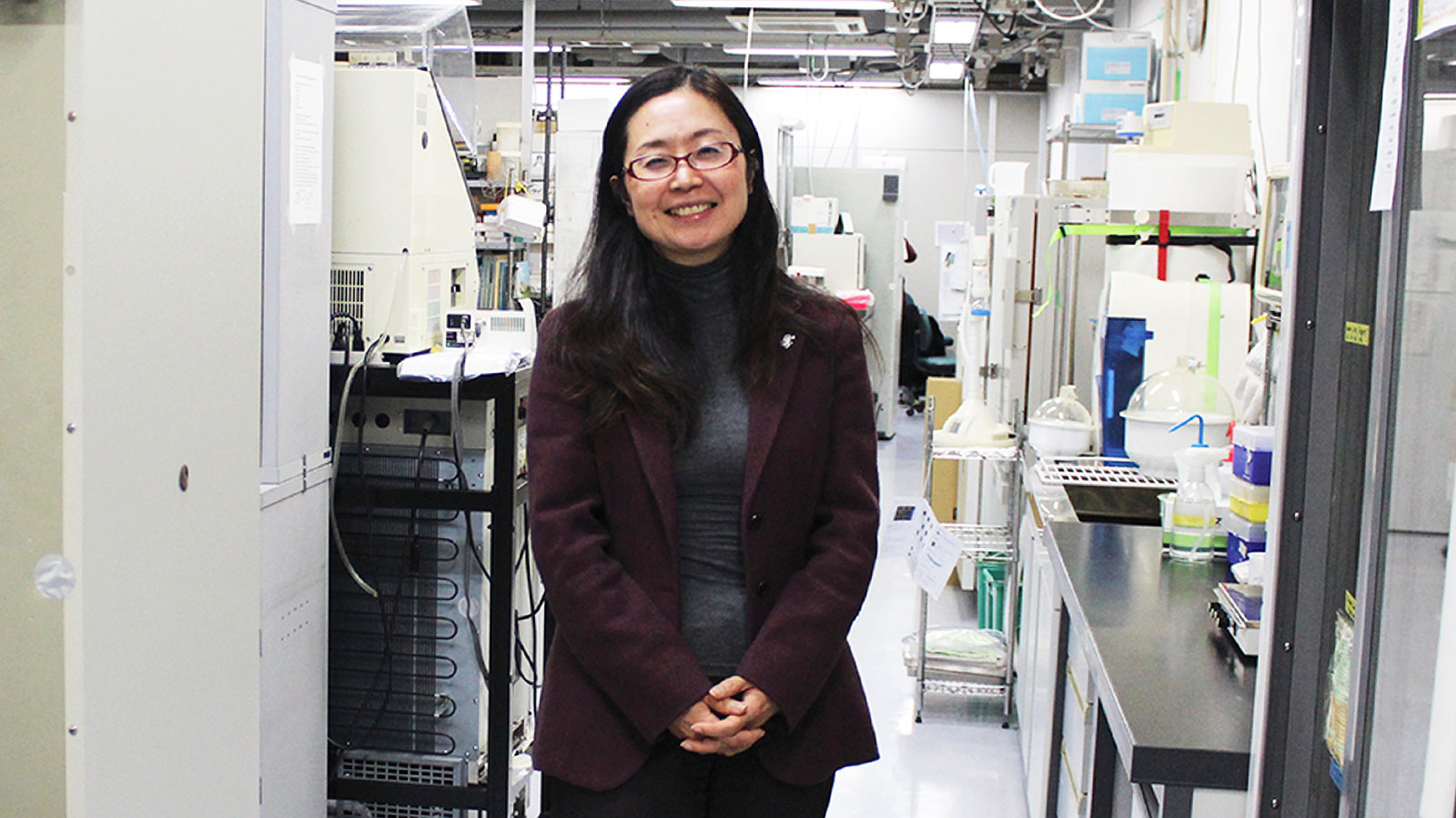
Noriko Osumi, a professor at the Tohoku University School of Medicine, is a well-known name in the industry and is synonymous with neuroscience communication. Alongside conducting research work, Professor Osumi works as head of PR in Tohoku University’s PR team and the Tohoku Medical Megabank Organization, making her someone who can lend strength to Tohoku University’s PR from a scientist’s perspective.
Professor Osumi won us over with her charm as we discussed scientific communication from the perspective of the scientist as well as the value and meaning behind research communications.
The objective behind having an in-house research communications team
It appears to me that in the past, when pamphlets or other materials were prepared for university PR as mandated by the general affairs department, it was never done with the aim of making the university appealing to its stakeholders. They would merely be budgeted, the number of copies decided, and the rest outsourced. As a result, the the various finished products are all over the place and don’t seem connected. This makes them ineffective.
In my opinion, having an in-house communications team addresses this problem for a university. When you do it yourself instead of using a third party, you can think about how to go out and sell the value of what you are doing. There is a lot of merit in having people within the organization working on communications instead of leaving it all up to a PR company. Investing in PR personnel has allowed the PR of the head office at Tohoku University to develop by leaps and bounds over the last five years.
The global communications team in the head office employs two full-time members who are fluent in English and two Japanese nationals who are proficient in the language. These four members liaise with staff from the university head office through a system set up over three to four years after the earthquake. In my opinion, the global communications section of Tohoku University’s website stands head and shoulders above those of other Japanese national universities.
Scientists as pets and scientific communication
In the context of scientific communication, I am an advocate of the “scientist as pets”
theory. By that, I mean scientists basically have a pet-like value to the public. I want them to see scientists as adorable, approachable creatures.
I wouldn’t necessarily stop researchers from hiding away in their laboratories, but I do think we need people who understand the importance of being involved in society. In some industries—like sports and art—everyone involved forms a community. In the scientific world, on the other hand, the impression you get is of a handful of scientists working in isolation on whatever they want. It’s no longer like in the past when scientists had a lot of money to do their research. Today, they use taxpayers’ money, and that’s why it seems important to me to think about how we can make them endearing to the public.
Ever since I worked on the third and fourth MEXT Basic Plans for Science and Technology, I have been arguing from the perspective of the researcher when it comes to the importance of scientific communication. Closer to home, I served as the first head of PR after Executive Director Yamamoto asked for a PR department to be created in the School of Medicine, and this allowed me to strengthen the talent pool working on university PR. Back then, the team comprised scientific communication experts, those responsible for the website, designers, and others. They now work in the PR strategy team for the Tohoku Medical Megabank Organization. I believe my job is to convey the importance of PR from the perspective of the researcher.
Learning about the difficulty of scientific communication when I was young
I was the sort of child who liked to spend his summer holidays working on illustrated diaries or the class newspaper, so I think, at heart, I always had a journalistic approach. Another factor is that my father was a whale researcher.
Commercial whale hunting has been banned for decades, but the reason the US came to Japan in their black boats in the first place was to load up on supplies at a whale hunting base. When Japan bashing was popular, it became the most convenient way to attack Japan. My father would always participate in global conferences on whale hunting on behalf of scientists, making empirical arguments over many years that the population of whales could be sustained by controlled whaling. But it didn’t matter how scientifically strong the argument was, because public opinion was manipulated by politics. That image of my father battling remained with me throughout childhood. I think my interest in scientific communication also stems from seeing my father like that.
The pros and cons of research communication
The emphasis on research communication has pros and cons. I think one of the problems is that, in some quarters, research is becoming commercial. The , for example, showed that not only there was a problem with the science of the study but the research was marred by commercialization.
I think the effort put in by the research institution into the press conferences held about the STAP research was rare, even within the research industry. If no irregularities had been found and the research had continued, I think there really should have been some developments in the PR for the study. For example, why were Moomin seals stuck on the fridge in the laboratory? Because that year was the 100-year anniversary of The Moomins. That seems like a well-honed PR strategy. The strategy they developed got a popular actress to appear in women’s weeklies and other media that have nothing to do with the research industry. It was absolutely incredible.
I think we need to be concerned about how we should respond to these emerging aspects of commercialism in view of the future of research communications.
The future of Tohoku University and Japanese research communication
The stakeholders of university PR can be divided into three categories. The chief mission of a research university is to engage in pioneering research, so the key players are the researchers and the funding agencies, the next generation of students, and the public.
Tohoku University now does PR that takes the public into account. Their Science Café series has been held maybe more than 100 times, and it looks like a grand piano is going to be set up in the hospital mall of Tohoku University Hospital, with monthly concerts for the public. The global communications team is currently looking out for interesting research happening at the university. It plans on writing up press releases and the like to catch the attention of the media. I think they are seeing steady results in the form of media coverage and research findings being used practically .
When you look at what is happening in PR overseas, however, you get the feeling that there is still much to do. For example, Tohoku University is tilted toward the sciences, where 90% of students and staff are working in the sciences, but there still aren’t many members of staff in the university PR department who understand science and can articulate it. Compared with the situation overseas, it’s still rare for universities in Japan to hire professional science writers for their outbound science PR. In my opinion, it would be a step forward for research communications to find more people like this.

“Creating a Model for University Management That Will be Regarded as Japan’s National University Corporation”
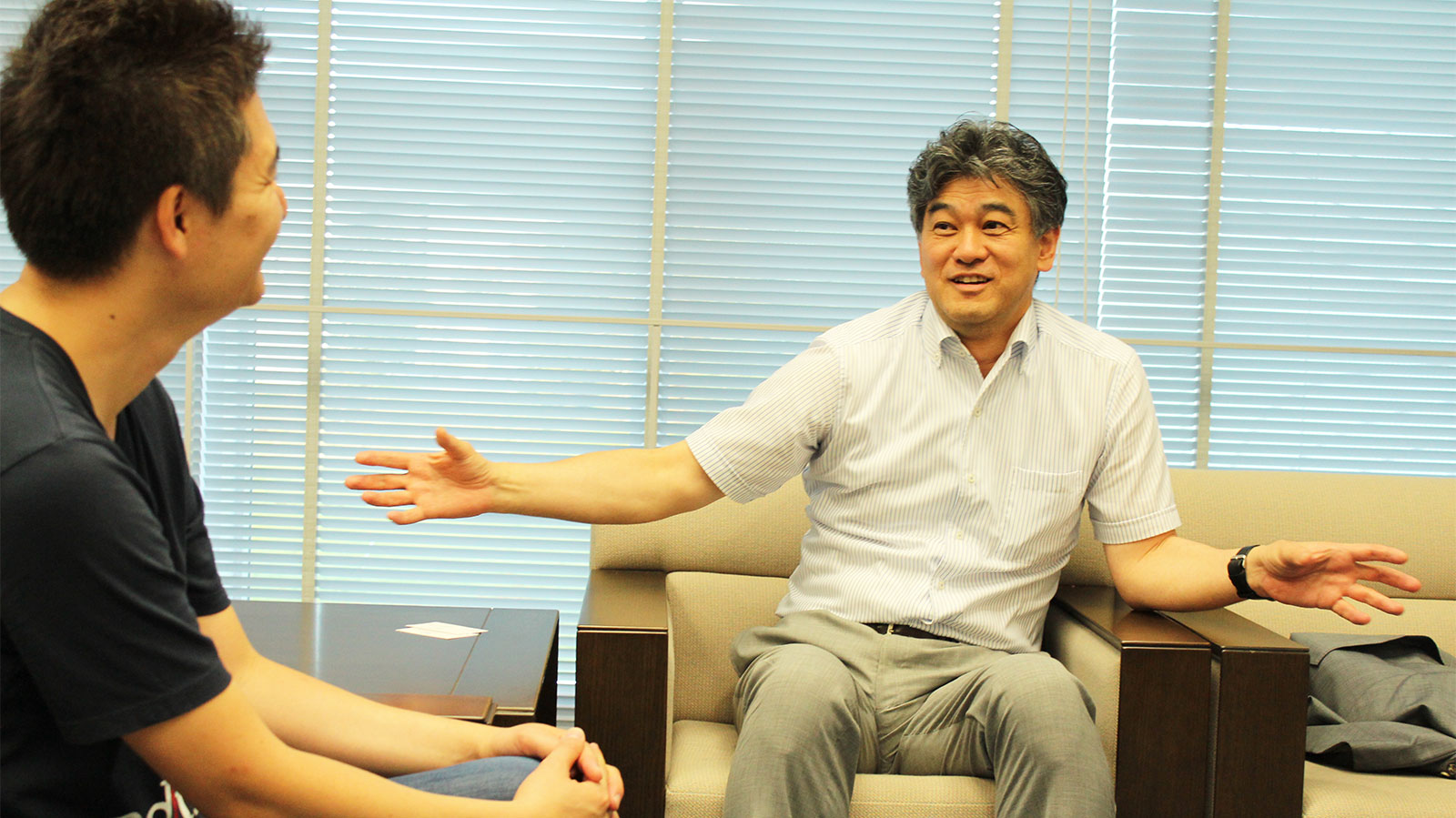
In this interview, Director and Vice President of Hokkaido University, Mr. Kazushige Kawabata, shares his thoughts on creating a new university management model that he wants to be regarded as Japan’s national university corporation.
In 2012, the Ministry of Education, Culture, Sports, Science and Technology (MEXT) mandated the establishment of the role of university research administrator (URA), a research management specialist, in all universities. However, each university interpreted this requirement differently. In this interview with Mr. Kawabata, we tried to understand how Hokkaido University implemented the role of URA.
Interviewer Makoto Yuasa
ーI hear Hokkaido University’s URA is making some drastic changes since you will take up the role of Research Director. Can you tell me about the vision?
The corporatization of national universities began in 2014. Since then, “university management” has become a buzzword used increasingly throughout Japan. The management of a university is not the same as the management of a corporate business. To understand what national university corporations and university management need to do, we need to look towards society, not the country. With Hokkaido University’s URA, I wanted to create a system to ask this question. I wanted to bring out Hokkaido University’s individuality and create a model that will be considered as the national university corporation of Japan. But, so far, it’s just an idea that is being tossed around (laughs).
ーI hear Hokkaido University’s URA is making some drastic changes since you will take up the role of Research Director. Can you tell me about the vision?
The corporatization of national universities began in 2014. Since then, “university management” has become a buzzword used increasingly throughout Japan. The management of a university is not the same as the management of a corporate business. What do national university corporations and university management need to do? To answer this question, we need to look towards society, not the country. With Hokkaido University’s URA, I wanted to create a system to ask this question. I wanted to bring out Hokkaido University’s individuality and create a model that will be considered the national university corporation of Japan. So far, it’s just been an idea that is being tossed around (laughs).
ーWhat are some of the significant differences between university management and corporate management?
National universities have established themselves by bringing together their own researchers, but they haven’t gone any further. However, since becoming corporatized, the function of collaborating with society, businesses, and local governments has become more important. For example, if the purpose of a business is to make smartphones, distribute them around the world, and impact the economy positively, then a university’s purpose is to predict a society where smartphones are popularized and foresee how it would change the structure of the industry.
One of the projects being conducted at Hokkaido University is Arctic research. We are attempting to identify a northeast passage connecting Europe to Japan, which has been created because of the Arctic ice melting due to global warming. If a northeast passage can be established, the logistics site for the Europe–Japan route will move from Kobe or Tokyo to Tomakomai in Hokkaido, thereby completely changing Japan’s logistics scenario. Tomakomai would be the epicenter of many social and industrial changes. We want to impact society by making Hokkaido University the base for the gathering of information such as data on global warming or discussions on national hot topics like the political disputes with China and Russia. Likewise, we want to involve businesses in the implementation of these research studies. This is the scale of social impact that universities can achieve.

ーWhat are your responsibilities as a research director?
Business management. That is, raising funds for research. Since the things we do are not only for the country but also for local governments and both the private and public sectors, I am always open to investors. It’s your investments and contributions that keep us afloat. I say, “Let’s change society together.” There are many leading businesses that have shown an interest in us, and we have also learned a lot from business owners. These interactions have helped us explore our personality as a university. It is this personality that has influenced the planning and establishing of the Global Facility Center by Hokkaido University’s URA and resulted in the collaboration between industry and academia.
ーYou have clearly stated that a Hokkaido University URA’s objective is to train and cultivate management specialists, but what is the motive behind this objective?
Universities, until now, have only had researchers and clerical staff. They didn’t have teams that planned, collected data for operations, or disseminated such data. They now have industry–academia liaison offices that have facilitated collaboration between businesses and the university, but they are not responsible for designing the university’s structure. My aim for the Hokkaido University URA is to fill in these gaps and create a team for university management, but there is no precedence, nor do I have any experience, and I had to build the URA organization from the ground up. I ensured that all URAs see the challenges I encountered in reforming university management. I believe this experience will help them cultivate the next generation of administrators. Being a part of the team that helps implement the vision will be of great help.
When it comes to the management of a university, it is difficult for researchers to do what they do and also attract businesses. There are many researchers who know nothing outside of academia and have little knowledge of an organization’s management. So even if they do manage to attract businesses, there is a stark difference between business corporations and university corporations. That’s why I believe people should first get their degrees, work as postdocs, or become assistant professors. When they are in their 30s or 40s, have completed a plethora of research, and have shown an interest in management, they may become URAs and take responsibility for the future of administration. However, this approach is used by Hokkaido University and may not be appropriate for all. Some universities have rigid decision-making processes across departments, and some like Hokkaido University have flexible processes but decisions are taken centrally.
ーWhat direction will Hokkaido University’s URA take from here?
Management work is extremely fluid. Because the circumstances around the world and the national university corporations are constantly changing, the URA is constantly evolving. Nothing is set in stone, and the URA will be the first to change. However, I want to create at least one new model despite the current operations—one that presents Hokkaido University as Japan’s national university corporation. Japan has always aped America, but we really need to create a Japanese university model, one that would make the Americans be in awe of Japanese universities. That’s what really gets me going right now.

The pioneers of a new university era gather – The Hokkaido University URA symposium
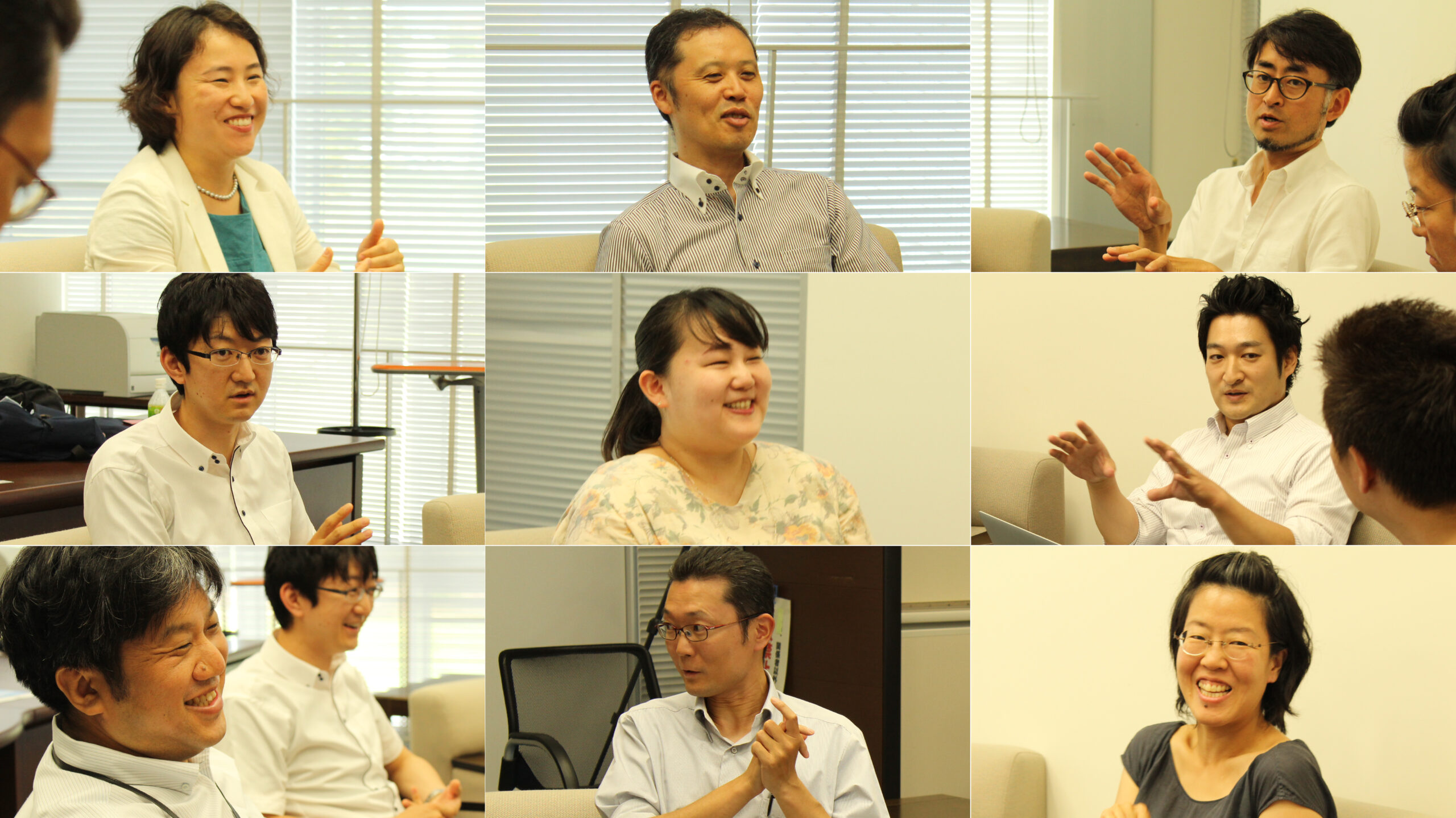
I spoke to the URA office members, those who have stood at the forefront of an era when universities are making significant changes with regard to the status of the URA. They shared their thoughts about Hokkaido University’s URA and what the future holds.
-What is everybody’s definition of a URA?
Uehara I’ve only been a URA for six months, but the job is different from what I had thought. A Hokkaido University URA is more of a project manager than a personal support officer, right?
Furuhata That’s right. It has also been six months since I joined, but if I were to define my job, I’d say it’s one where I look at the university both subjectively and objectively, think about what can be done to improve the university, and work to realize an ideal situation. Not everyone in the department with a problem is able to execute its solution. The URAs work below the executives and are expected to think and act like an implementation unit.
Wada I can compare a URA to glue. Both the teaching and clerical staff have defined positions and roles, but you need glue to bring people and organizations together when working on new things.
Omata I think a URA is the “Public Security Section 9” in the anime Ghost in the Shell. Even though each URA has a different job, their work is connected to the university’s mission or the region or country’s mission. I consider myself to be that kind of flexible component.
Tanaka A researcher’s work is most innovative when conducting research activities based on his or her personal motivations. In order to support such an activity, we need to think about the university as a whole and the budget required to maintain that environment. I think a URA’s mission is to establish the Hokkaido University brand and create an environment where teachers are able to work well.
-The URA work here is interesting!
Uehara Becoming a URA has been interesting because I’ve found new experiences and done things I’ve ever done before as a researcher, such as learning how decisions are taken by the university’s management, the administration, or the work.
Furuhata It’s really interesting to be connected to people in every single department. I think this is a unique aspect of a Hokkaido University URA, but because it is an organization directly under the director, we get a macro perspective of the university, which allows us to take on large projects. Former researchers such as myself don’t fit in a standard role in an organization. That is why I think it is very important for universities to create an environment where the most can be made of a researcher’s individuality.
Kato Not only are we able to directly speak to the university’s executives and teachers but also those in charge when we go to the MEXT. I don’t think I could have experienced such things had I continued on the path of a researcher, and for that, I am glad.
Wada Like Mr. Kato, I, too, find it incredibly interesting to learn again about my own university’s appeal by speaking to people at the MEXT; the Ministry of Economy, Trade and Industry (METI); and the Ministry Agriculture, Forestry and Fisheries (MAFF). Also, because the role allows us to work closely with executives and also traverse organizational boundaries, we are able to collaborate with other departments and begin projects with many teachers. These are things that can’t be done if you’re not a URA. It’s such a thrill, and I’m so glad I have this job.
Omata I’ve worked at a lot of places, but I don’t think I have ever worked with such great people, and that is what I am most happy about. I’m not trying to flatter anyone. Sharing my own thoughts and vision with other URAs allows us to create synergy.
Takagi The most interesting thing is meeting many researchers and being able to listen to their stories about being in the frontline. If one can suggest ways of improving research activities that are thought to be inconvenient so that they can be conducted more smoothly, then the work is worth doing.

-What are some difficulties that URAs go through?
Kato Well, there are a lot of difficult situations. Since the URA is involved with a variety of departments, roles, and hierarchies, not everything will run perfectly. It may take some time to adjust within the university when working on new things. What the other person says is, of course, correct, but sometimes I wished that they would allow us to be a little more flexible. There are times when difficult negotiations have led to stress.
Furuhata I must apologize, but I have never found the job to be difficult.
Kato That’s impressive!
Ebata Impressive. That is wonderful!
Furuhata It is because a URA is able to make use of any experience. The more experience you have, the better. I have previously worked at the Ministry of Foreign Affairs and international organizations, but the structure of these organizations is different. There were times as a URA where I thought I couldn’t do this anymore or felt helpless, but the URA is a new role, so it’s normal to have such thoughts. If you’re ever lost or you find yourself on shaky ground, just discuss it with someone and you may receive a response.
Wada The difficulty of being a URA is that a university is an organization that does not work towards one goal like a business would. Because it is such a diverse organization where people come with varied interests and intentions, when working on one project, a lot of effort is required to bring people together and produce something really great. I think that’s where the challenge lies.
Okada A Hokkaido University URA needs to break down the various levels of work from planning to paperwork. Because it is a flat organization, each person is continuously working on various tasks regardless of how many keep coming up. It is fun, but can honestly be draining (laughs). Sometimes one or two years is not enough to get to a point where something has actually been accomplished.
-Why did everybody here become a URA in the first place?
Kato I worked at a research institute until my term expired and I had to find another job. I was torn between staying as a researcher and becoming a URA. I thought that supporting the university’s research could lead to more discoveries compared to what I would achieve by conducting research on my own. I also thought I could be in a position where I could see cutting-edge data before others did.
Wada I wasn’t a researcher originally. I was at an innovative venture-type company where I commercialized new inventions and R&D, and human-resource work. I was interested in an organization’s assets. When I came back to Hokkaido, openings for a URA had just come out. I didn’t really understand the description when I read it, but I applied thinking of it as a university goldmine or a job where I would uncover potential. In the interview, I threw in a one-liner and then they hired me (laughs).

-What did you say?
Wada I showed them a picture of a bridge and said, “You might not be able to see this, but I am highly mobile!” I think I was hired because they laughed at that (laughs).
Furuhata Did you say “a bridge between administration and teaching staff!” or something like that?
Wada I didn’t say that (laughs).
-Do they ask you to come up with one-liners in the URA interviews?
Ebata They definitely wouldn’t. (laughs)
Furuhata They made me give a presentation afterwards.
Kato They didn’t have that when I was there. Did they get stricter because I did something wrong? (laughs)
Takagi I didn’t need to do one either. But they did make me write a composition.
Kato Aren’t they trying to understand how the applicant thinks or gauge their personality from their presentations or jokes?
Ebata No, no! They have never asked the applicants to tell jokes! (laughs)
Furuhata After I worked as a teacher at the university, I was in a specialized agency for the UN in Canada. It was a very interesting job because I interacted with various people in an international organization. When I returned to Japan, I dreaded the idea of once again being confined to my research laboratory. It was when I was looking for a job after returning that the openings for the URA position were announced. The URA role was well suited for me since I had a PhD and I could utilize my experience and skillset. I decided on Hokkaido University because it provided a future—their URAs are given extended contract periods and can work on a tenure track, things that other universities did not offer.
Uehara Like Mr. Omata said, a tenure track for Hokkaido University URAs was quite appealing. I previously worked in the research laboratory of a company, but I wanted to try and do management planning work as a head of R&D when I reached my 40s. Although that is why I was interested in becoming a URA, going through the experience of being properly hired, especially as a full-time staff at Hokkaido University, was a strong enough motive to apply.
Takagi Me too. I followed my husband to Hokkaido, but I can’t get hired by private companies with a PhD. So at the beginning, I worked as a research assistant at the university, but what I realized when I was supporting the researchers’ clerical work and research projects was that, because of their strong sense of independence, many researchers had poor perception based on their instinctive wariness to rules and paperwork. I was praised for being able to quickly finish routine work without any resistance. I started thinking about my aptitude for such work, and that’s when the initial opening for URAs were announced. Research assistants were usually hired after five years, but it seemed it was a different case for Hokkaido University URAs.

-What do you think Hokkaido University URAs should do for the future?
Uehara Although current Hokkaido University URAs have their own responsibilities, I think they should think about ways to work as an organized team.
Furuhata It’s very difficult to explain what the role of a URA was at the beginning. My acquaintances and colleagues would ask if I’d come back if there was a research position and I would wonder why they’d ask me that. I’m having fun at this job, because I believe I’m doing work that researchers cannot do. It’s not like I’m sad or I have regrets or anything, but I wish they would be more aware of the importance of this job. But that is my responsibility. A URA wants to work so that others can understand that a URA does things that only a URA can do. It will be a very long time before people at the university find the URA role appealing. Hokkaido University is working towards cultivating this kind of thinking.
Kato I jokingly tell people that I have joined the URA mafia and will control the entire university (laughs). Even if Hokkaido University URAs are management specialists, can we really manage the university’s future? I’m not sure about this yet. But as people who understand all aspects of the university, we can be in a position that informs outsiders, the teaching staff, and clerical administration about the university’s objectives and thinking. When the time comes, I’d like it if they became fully aware of our work as opposed to them not knowing who we are.
Wada I somewhat understand Mr. Kato’s comment about the URA mafia. The university’s executives are replaced every few years, right? I believe there needs to be some sort of structure where this trend can be examined from time to time and the pros and cons can be determined over a long term even if people are replaced. Also, like what Mr. Omata said, I want the URA to be an admired and enjoyable profession.

“This is the heart of Hokkaido University’s URA!”
Mr. Shingo Ebata

While specializing in cosmochemistry, I researched the origins of the solar system by using advanced tools for analyzing asteroid samples brought back by Hayabusa (Japanese robot asteroid mission) and studying meteorites. As I made progress in my research, I became strongly aware of the huge impact analytical instrumentation has on research, since researchers and research infrastructure are the two most indispensable factors of research. I was involved in the development of the world’s cutting-edge analytical instruments when I was a post-doctorate/assistant professor. During this time, I realized that the university used a large number of impractical analytical instruments and that the university’s management strategy was poor. That is when I diverted my attention to management. I wanted to do something to benefit not only Hokkaido University but the whole of Hokkaido and Japan.
Coincidentally, the Hokkaido University URA office posted an opening at the time. I was keen, so I jumped onboard. A URA needs to develop an instrument-sharing system, facilitate the transfer of skill among the technical staff, and oversee facility maintenance and overhead expenses; in a nutshell, the URA utilizes the university’s brand and assets. In the current scenario, where the government’s budget is being steadily reduced, a new business model is required. This business model needs to incorporate the use of new methods to increase the university’s societal value, which will be assigned a financial value and factored in the budget.
The Global Facility Center was established in 2016 with the aim of serving as Hokkaido University’s next-generation management strategy. Before its establishment, there were very few people who recognized the value of the university’s equipment and technical staff. However, after the Global Facility Center was founded, many efforts were undertaken all over the country to establish it as one of the landmarks of Hokkaido University. The efforts proved successful; not only was the university acknowledged throughout the country, but it was also able to secure a bigger budget.
Things have been exciting since. We’ve begun new initiatives such as the “Equipment Market” and “Shisaku Solution.” I haven’t restricted myself to the extended budget. As the Deputy Head of Center, I have increased the value of Hokkaido University and have been involved on a daily basis, in the process realizing my vision and achieving results.
The objective of Hokkaido University’s URA is to reform the system at the university level. Vice President/Director Kawabata said that each URA should pursue the URA office’s mission. The URA is fairly new role, so it is unclear how things will pan out. While each URA is working towards achieving tasks in line with their interpretation of the role, the aim is to reform the system at the university level. I think Hokkaido University is functioning smoothly because the system is in place. A Hokkaido University URA is essentially an assistant director. Because URAs undergo on-the-job training, they are bound to encounter some conflict. However, each day is exciting because you can see each plan in detail and how it is linked to the university’s management strategy.
Leveraging expert communication skills to create resources that can be shared across large collaborative research projects for the promotion of projects.
Mr. Shingo Tanaka

Originally, I specialized in ecology and researched the evolution and adaptation of insects to agrochemicals and other environmental changes. After I received my PhD at Kyoto University, a sustainability science research project was introduced at Hokkaido University and I was keen on becoming involved in URA work that involved collaborating as a post-doctorate researcher. I became interested in working on large-scale projects assigned by the Ministry of Education, Culture, Sports, Science and Technology (MEXT), as this involved a range of tasks from acquiring external funds to coordinating with the teaching staff from various departments. In 2012, I applied for a position offered by the URA office at Hokkaido University.
The hottest project right now is the ArCS: Arctic Challenge for Sustainability. This project was started with the aim of creating a flagship research project that will become the core function of Hokkaido University and support the entire university with its resources. Arctic research is not limited to the natural sciences; it requires collaboration between disciplines—from the humanities and social sciences to engineering. It also requires collaboration with external organizations. Since no one in the university has performed that level of research, I worked towards creating a new department. We have just begun working on two projects—a national MEXT project related to the Arctic region and a project called the Joint Usage/Research Center—both in collaboration with the National Institute of Polar Research (NIPR) and the Japan Agency for Marine-Earth Science and Technology (JAMSTEC).
You need to overcome the cultural differences between institutions and disciplines to complete tasks smoothly. The role required supporting this environment and encouraging researchers to pursue their research. I think Hokkaido University’s top-down decision-making structure is its most unique aspect and that is why the URA plays an increasingly larger role. Institutional research (IR)—analyzing the university’s strengths—plays a big role in that area. Decisions are taken at the top based on the analyses and we execute the project accordingly. As a result of our close relationship with the top decision-makers and direct access to the heads and managers of each department, it is easy to carry out large and complex projects progress smoothly. A project that would take one to two years to complete with a bottom-up structure could be completed in about a week.
To control information is to control the university’s management strategy—to freely use all data to create the university’s image.
Mr. Naosuke Okada

While studying physical oceanography, I investigated sea flow. I specialized in computer simulations, and created virtual seas and investigated how the sea flow changed under specific circumstances. After attaining my degree at Hokkaido University, I worked at the National Institute for Environmental Studies in Tsukuba city during my post-doctorate studies where I took part in a research project focused on measuring global warming. I was then asked by a professor from Hokkaido University to assist with the operation and management of a program called the Global COE. While working there, I discovered that the job was right up my alley. I enjoyed thinking about how research could be done more efficiently and found it even more exciting than doing research itself. Around that time, I began thinking about a career change because the MEXT had just introduced the role of URA in universities across the country.
My responsibility as a URA is to carry out IR, that is, gather and analyze research information. I initially handled research information such as and citations. In the future, I would like to create a system that develops the university’s research strategy or, in a broader sense, an evidence-based university management strategy, by first learning how to centralize external fund acquisition, intellectual property information, etc. As part of our strategy, one primary focus is identifying Hokkaido University’s strengths. Now that Hokkaido University is fiercely competing against other institutions, it can use its uniquely curated databases, tools, and data to plan the building of a research base. Further, the university’s executives, department heads, and researchers need to assess where they stand in order to generate research of higher impact. We have been conducting detailed analyses for each department and field of study, and making them available to the teachers in each department.
I believe that nothing can be achieved if you do not create a self-image, and I believe Japanese universities have yet to achieve this. This is an incredibly difficult task. There are many factors to take into account when designing a business, such as sales, profits, stocks, and other complexities. By crafting a new identity for Hokkaido University, I believe we can create an environment where the faculty can conduct research with greater ease and efficiency. By making use of analyzed information and the university’s strengths, the URA can create a better environment for the whole university. A university that is progressing into the future: that is what I want Hokkaido University to be.
Junichiro Yamazaki: Head of URA Station

The objective of the URA office’s initial plans led by the was “to ensure the research time of researchers.” As a result, when the URA compared researchers to writers, it gave the implication that they were editors. But the expectation from universities has changed. In large projects that involve businesses or other organizations, typically, it is difficult to see progress when just one researcher is involved. The URA needs to assume the role of a research producer in the office of the president, director, vice-president, or lower rungs of management, and make changes so that teachers are able to support a part of that project. To be able to circulate projects, a URA—whose position until now has been that of a research supporter—needs to be able to talk about the vision from a managerial standpoint. I believe we are currently in the transitional phase of cultivating such a staff.

